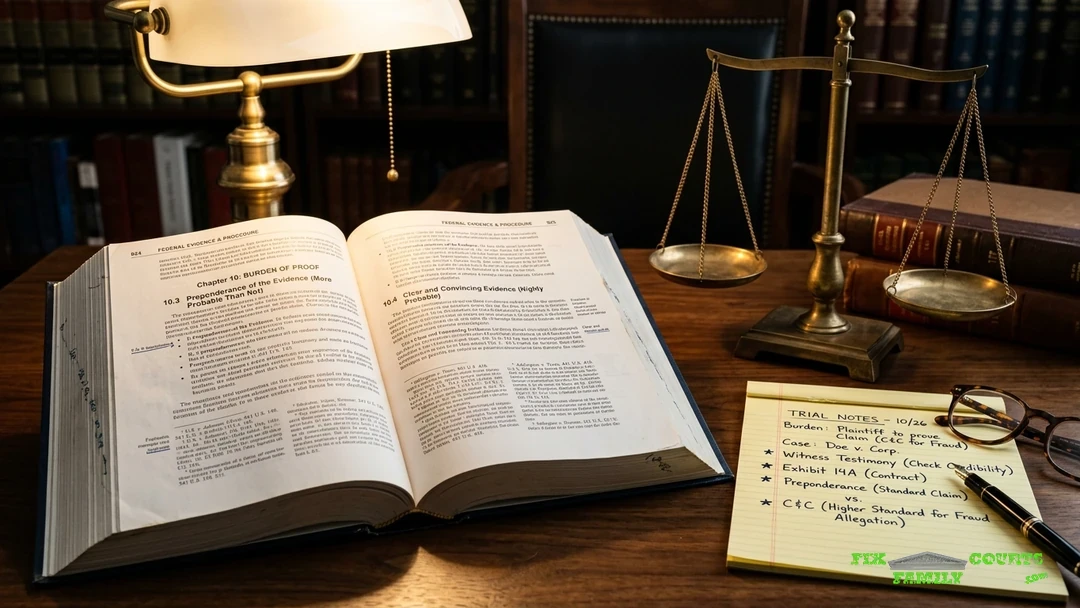
Standard of Proof
Preponderance of the evidence vs. clear and convincing evidence might be how you know it. After this post, you will be on your way to schooling even the best of them on why the standard of proof used in your family law hearing matters.
Do not ever assume that a court knows to use the raised level of proof. And once again, just because you ask for it to be raised does not mean the judge is going to agree. But remember: not persuading the judge does not mean that your argument does not have merit. So let's strip down this subject so that the courts cannot take advantage of you on this one anymore.
One of the purposes of setting a standard of proof is to reduce the risk of errors that judges might make regarding an individual's rights. Naturally, if the family courts are assuming that you have no rights, then this issue will not be a priority for them. Judges who are not interested in hearing about standard of proof generally want you to just do as they say and go away. It is much easier for them to sweep those rights under the rug and place the burden on you to garner their support or prove innocence.
Don't confuse burden of proof with standard of proof.
- • Burden of Proof: Determines which party must prove their case.
- • Standard of Proof: Determines how much proof they must show (the quantum of evidence).
The burden of proving guilt or unfitness is completely different from the standard of evidence that is used. If you read the first Daily Tool on Disposition Hearing, you will understand the difference.
How is standard of proof generally determined? Standard of proof is set by statute, often based on a Supreme Court opinion. It is generally determined based on the type of rights that are being affected by the lawsuit.
If you noticed, small claims court where two parties are disputing over a small sum of money requires very little evidence and not very much procedure. This is because if the judge makes the wrong decision and awards the money to the wrong party, the losing party is only out a small sum of money. So the risk of error and the effect that this error might have on a person long term is much less than the risk of error of getting your parental rights wrong.
The Constitutional Principle: Risk of Error
When something as important as your rights and time with your child are in question or being attacked, you would think that a higher level of proof than "preponderance of the evidence" would be required. Actually, you can make a powerful constitutional case for why it is required.
So let's see what happens if you don't have a statute that requires more than "preponderance of the evidence"? Well, you can ask for a higher standard of proof to be required in your pleadings, and you can argue for it at your hearings as well. You'll need to be prepared, of course, to provide why this applies to your particular case when the judge has probably been using the lowered standards for 10, 20, or even 30 years.
First, you would provide an example from, let's say, a First Amendment case where the justices argued that a higher standard of proof is required when such an important right is being affected. You can use scholar.google.com and search through cases using keywords like "freedom of association," "1st amendment," and "freedom of religion," and then search for the words "preponderance" and "clear and convincing" within the same case. Read through the reasoning to see if the justices address this argument. There are many cases out there where they share their reasoning on when and why a raised standard of proof must be used.
Then you'll need to explain how your relationship, your rights, and your time with your child are part of your First Amendment "freedom of association" rights. And also introduce caselaw that refers to your parental rights as fundamental rights. Why? Because you will see in the caselaw that the majority of fundamental rights are protected with "clear and convincing" evidence.
This is because—you guessed it—these rights are so important that they need a higher level of protection from judges inadvertently making a bad decision.
Building the Due Process Fortress
Judges make bad decisions in child custody and divorce cases every day. Protect yourself and your child from these arbitrary and capricious errors by persuading the judge that proper due process requires this raised level of proof.
This, in combination with requiring the proper type of hearing (see the Daily Tool on Disposition Hearing), builds a fort that is far more difficult to penetrate with false allegations, parental alienation, or the manipulative behaviors that many experts and judges are fooled by.
Once you understand how protective raising the standard of proof can be for you and your family, you will surely want to incorporate this into part of your presentation to the court.
After you put your persuasive argument together, head over to the local law library or order a basic book on evidence for your State so that you can learn how to block evidence that doesn't meet the standards, as well as how to enter the evidence to protect yourself from the onslaught of attacks.
Protect Your Parental Rights with Constitutional Training
Reason Through & Protect Your Parental Rights
Learn how to effectively reason through your constitutional rights and protect them with our foundational books and comprehensive training courses.
Receive Daily Tool Updates Directly in Your Inbox
Be sure to subscribe to our website and receive notices when the new Daily Tool is posted each day.
*Picture credited to: Fix Family Courts Archive
See more at: Daily Tool: Rebuttable Presumption
Fix Family Courts Resource & Leadership Hub
Training & Media Resources
Watch free videos here and learn more about these types of hearings and due process.
Leadership & Published Works
Strategic Parental Rights Strategist, Instructor, Constitutional Scholar, and Author
Divorce Solutions and Child Custody Solutions
- ● Co-author "Not in the Child's Best Interest" (Book on parental rights and children's rights)
- ● Co-author "Protecting Parent-Child Bonds: 28th Amendment" (Book includes guide for legislators)