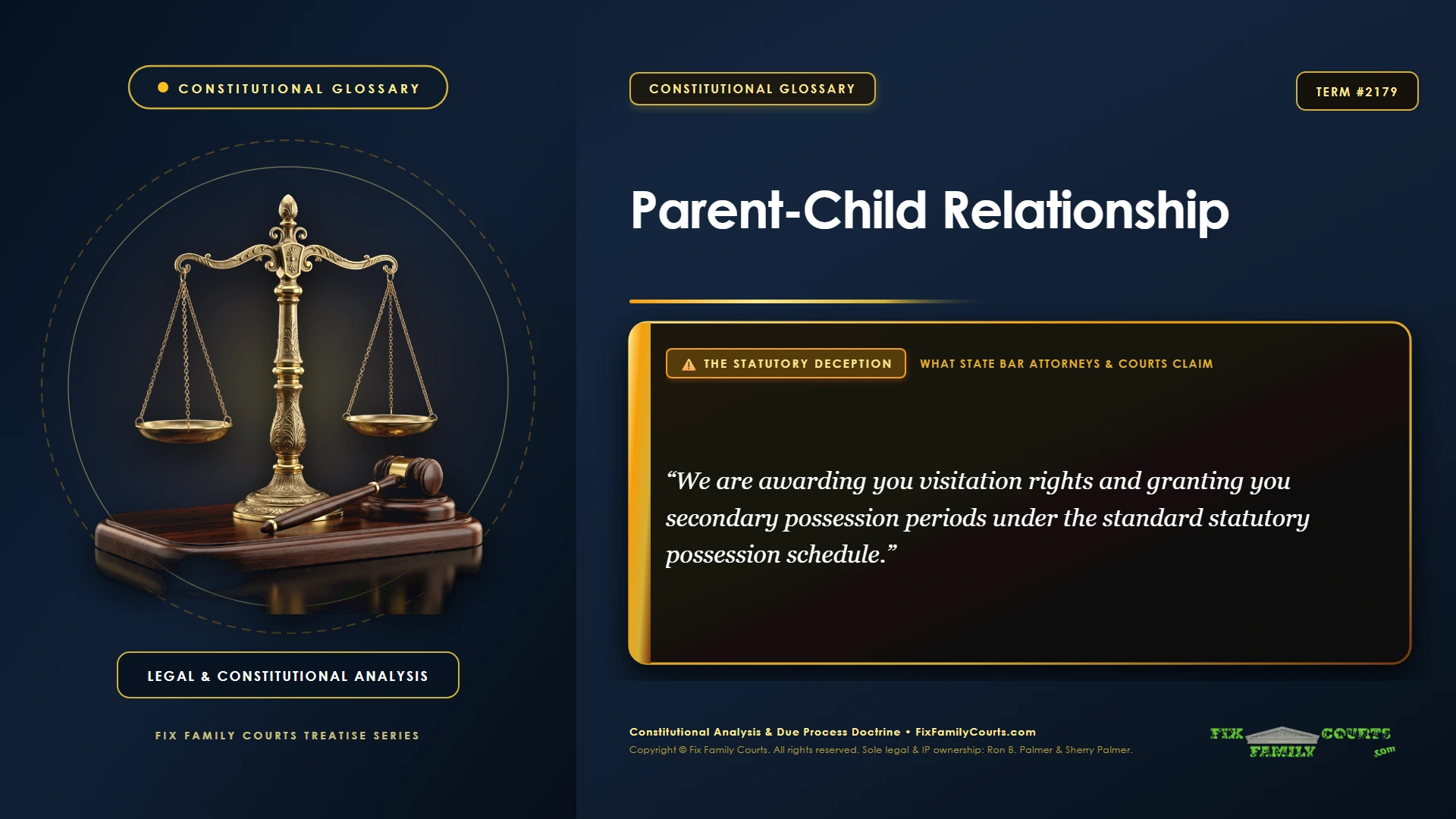
Parent-Child Relationship
An intimate and expressive familial association protected by the First and Fourteenth Amendments at the strictest standard of constitutional review.
Treating Inalienable Rights as State Privileges
Family courts and lawyers routinely tell parents: "We are awarding you visitation rights and granting you secondary possession periods under the standard statutory possession schedule."
The state did not create the parent-child relationship and cannot "grant" what already belongs to parents by natural right. The bond between parent and child is a preexisting fundamental liberty interest shielded from state rationing.
The Intimate & Expressive Association of the Family
The parent-child relationship occupies the highest summit of constitutional protection recognized by American law. It combines the substantive due process liberty of the Fourteenth Amendment with the intimate and expressive association guarantees of the First Amendment.
It is solely through intimate daily association that a parent fulfills their natural duty to educate, mentor, nurture, and pass down cultural and religious conscience to their child. When a court intrudes into this relationship between fit parents, it infringes upon core expressive liberties that require strict scrutiny review.
Family Relationships as the Quintessential Intimate Association
“Family relationships, by their nature, involve deep attachments and commitments to the necessarily few other individuals with whom one shares not only a special community of thoughts, experiences, and beliefs but distinctively personal aspects of one's life.”
As ruled by the Supreme Court in 1984, family association represents the quintessential protected relationship immune from unwarranted state interference.
Parenting is Expressive Speech and Assembly
Teaching values, comforting distress, and participating in bedtime routines are expressive acts protected by freedom of speech and exercise of conscience.
Restricting a fit parent's time operates as an unconstitutional state limitation on intimate familial communication.
The "Visitor Status" Demotion Trap
Accepting an alternating weekend schedule reduces a fit parent from an active, equal guide into an occasional entertainer.
Rationed contact destroys the depth of intimate association, impairing the parent's ability to transmit values and nurture character.
Assert that fit parentage is an indivisible fundamental right entitled to equal physical time and equal decision-making authority.
How to Assert the Intimate Association of Parent and Child
State this formal objection whenever the court contemplates limiting your parental relationship:
"Formal Constitutional Objection: I object to any order that restricts, limits, or rations my parent-child relationship as an unconstitutional infringement upon my fundamental rights of intimate and expressive association under the First and Fourteenth Amendments."
"The parent-child relationship is a fundamental liberty interest that precedes the state. Absent an adjudicated compelling state interest achieved through the least restrictive means, this Court lacks authority to degrade a fit parent to visitor status. I move for equal physical custody and equal parental authority."