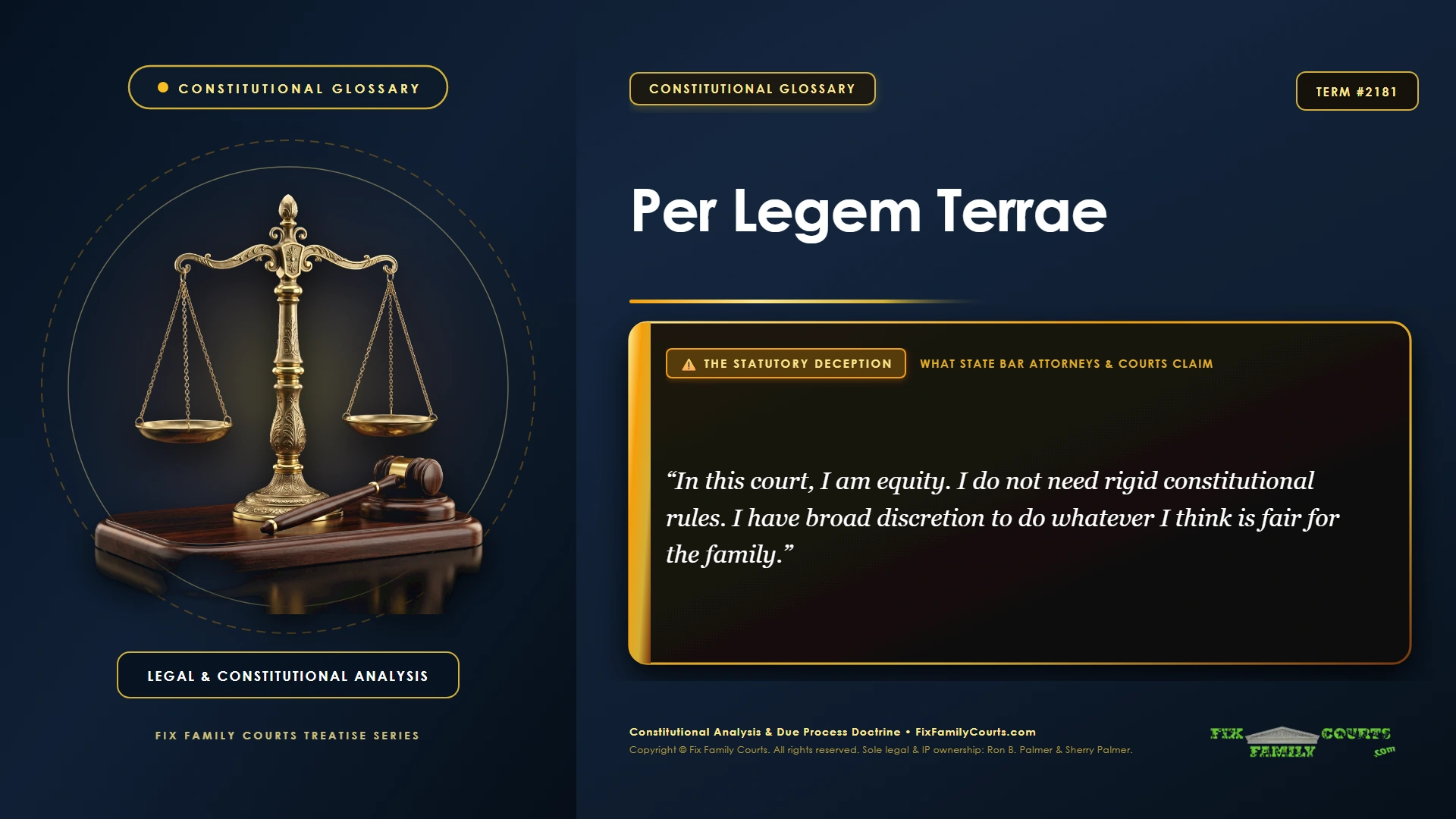
Per Legem Terrae
"By the Law of the Land": The 800-year-old Magna Carta foundation that strips monarchs and judges of arbitrary discretion over family liberties.
The Modern Judicial Deception
Family courts and lawyers routinely tell parents: "In this court, I am equity. I do not need rigid constitutional rules. I have broad discretion to do whatever I think is fair for the family."
This assertion claims absolute monarchical power. For eight centuries, Anglo-American law has strictly prohibited judges from replacing established positive law with their personal concept of "equity."
The 1215 Genesis of American Due Process
In 1215, English barons forced King John to sign the Magna Carta at Runnymede. Clause 39 declared: "No freeman shall be taken or imprisoned or disseised of his Freehold or Liberties... but by the lawful judgment of his equals, or by the law of the land (per legem terrae)."
As Sir Edward Coke expounded in his Institutes, the words "law of the land" mean due process of law. They guarantee that no government magistrate may seize a citizen's life, liberty, or property through arbitrary discretion.
Due Process is Synonymous With Per Legem Terrae
“The words, "due process of law," were undoubtedly intended to convey the same meaning as the words, "by the law of the land," in Magna Charta.”
As ruled by the Supreme Court in 1856, the Constitution restrains all branches of government from arbitrary intrusions. A state family court judge who disregards constitutional standards operates in direct violation of the law of the land.
Discretion is the Law of Tyrants
Common law jurists established that unguided judicial discretion leads inevitably to tyranny and unpredictable personal rule.
Per legem terrae requires established procedures, verifiable facts, and fixed rules of decision before any citizen may be deprived of fundamental rights.
The "Family Court is Special" Trap
Judges often claim that family law cases are exempt from rigid constitutional principles because children are involved.
Arbitrary power exercised in the name of "the best interest of the child" is no less despotic than arbitrary power exercised in the name of the King.
Fit parents cannot be deprived of liberty except through positive, established constitutional law applied through strict procedural safeguards.
How to Object to Arbitrary Judicial Discretion
When a judge announces they are ruling based on personal opinion rather than positive law:
"Formal Due Process Objection: I object to the Court resolving this matter through unbridled judicial discretion rather than established positive law."
"From Magna Carta's per legem terrae guarantee through the Fourteenth Amendment Due Process Clause, the law of the land bars the state from depriving fit parents of fundamental liberties based on subjective judicial preference. I demand the application of the United States Constitution as the controlling rule of decision."