Answer
Why your formal Answer must do far more than deny allegations—it is your mandatory vehicle to plead affirmative constitutional protections and stop state waiver.
What Most Family Law Attorneys File
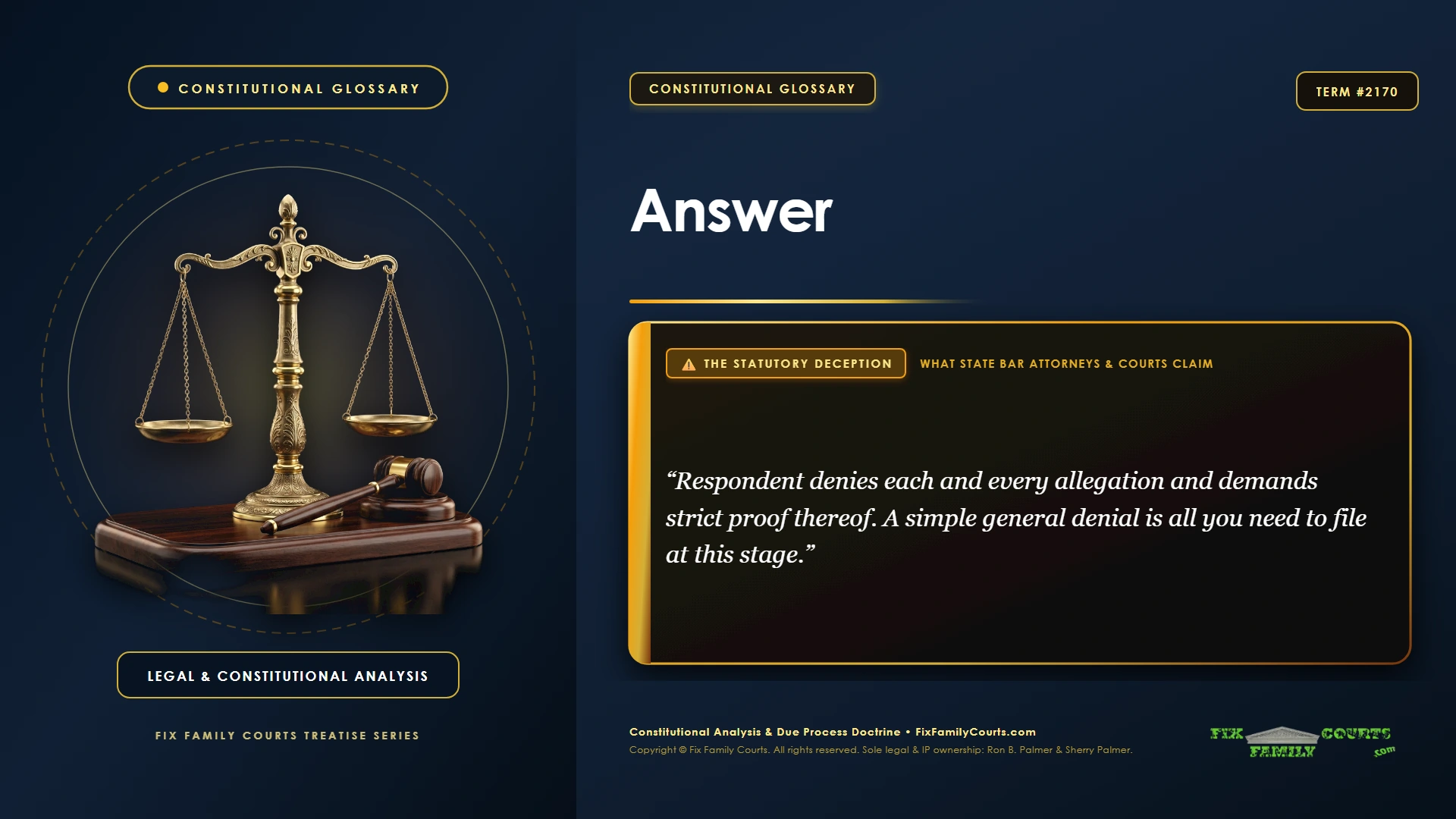
Family courts and lawyers routinely tell parents: "Respondent denies each and every allegation and demands strict proof thereof. A simple general denial is all you need to file at this stage."
Filing a generic denial without asserting your affirmative federal constitutional defenses allows state judges to treat your constitutional rights as waived, surrendering your federal protections before the first hearing even starts.
The Answer as an Affirmative Constitutional Shield
An Answer is the respondent's primary written response to the petition initiating suit. It establishes your formal appearance before the court and prevents a default judgment.
Crucially, under modern civil procedure, affirmative defenses and constitutional challenges must be specifically pleaded or they are deemed waived. Your Answer is where you must assert your fundamental liberty interest under the Fourteenth Amendment, plead the strict scrutiny standard of review, and challenge the court's authority to apply subjective "best interest" standards between fit parents.
Failure to Plead Constitutional Defenses Invites Judicial Waiver
“An affirmative defense is a new matter which, assuming the allegations of the complaint to be true, constitutes a defense to it and must be affirmatively set forth.”
If you do not assert your constitutional rights affirmatively in your responsive pleadings, appellate courts will frequently rule that you "failed to preserve error in the trial court below." Your Answer must explicitly reserve all federal rights.
Locking the Federal Issues on the Record
Federal claims must be raised at the earliest procedural opportunity to avoid state court procedural default doctrines.
An Answer incorporating constitutional challenges reserves the issues for direct appeal and federal certiorari review.
The "Default Judgment" Window Trap
Failing to file an answer by the state statutory deadline (often 20 to 30 days following service) allows the petitioner to take a default judgment.
In a default judgment, the judge grants the opposing party everything requested without ever requiring proof on the merits.
File your Answer on time containing both a general denial and explicit affirmative constitutional defenses demanding strict scrutiny.
Affirmative Constitutional Defense Language for Your Answer
Include this formal affirmative defense paragraph in your responsive pleading:
"Affirmative Constitutional Defense: Respondent affirmatively asserts that as a fit legal parent, Respondent's right to the care, custody, and companionship of the minor child is a fundamental liberty interest protected by the Due Process and Equal Protection Clauses of the Fourteenth Amendment to the United States Constitution."
"Respondent pleads that any statutory provisions authorizing this Court to reallocate or restrict parental rights based upon a subjective "best interest" standard without an adjudicated finding of unfitness or demonstrable clear and convincing harm fail strict scrutiny and are unconstitutional as applied. Respondent demands strict adherence to the United States Constitution as the supreme rule of decision."