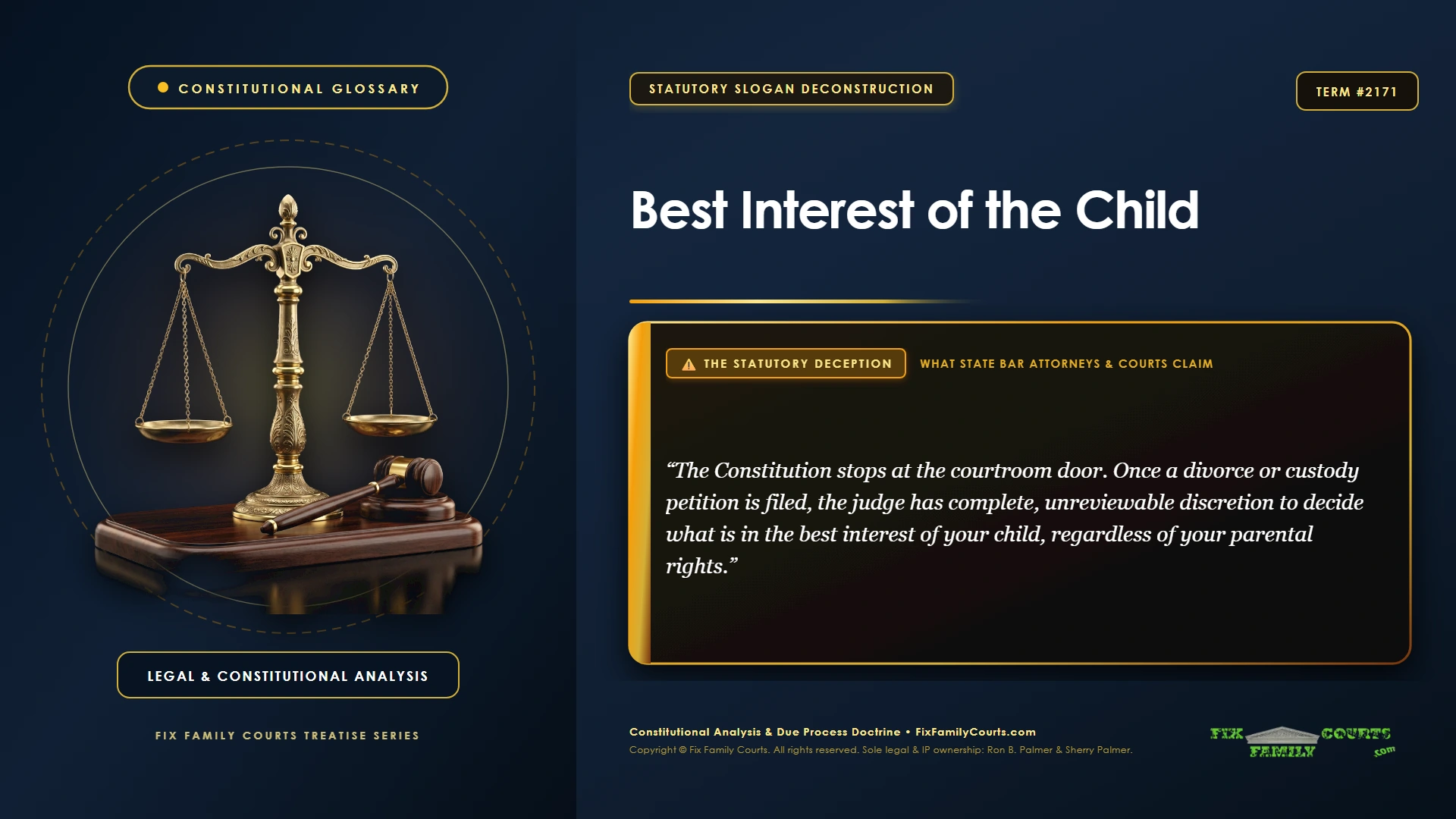
Best Interest of the Child
How domestic relations courts convert an administrative marketing slogan into an unconstitutional license to strip fit parents of fundamental constitutional rights.
What Family Courts & State Bar Attorneys Claim
Family court judges and litigation attorneys routinely tell parents: "The Constitution stops at the courtroom door. Once a divorce or custody petition is filed, the judge has complete, unreviewable discretion to decide what is in the best interest of your child, regardless of your parental rights."
This assertion is a total legal falsehood designed to frighten fit parents into submission, force expensive custody evaluations, and justify commercial child support extractions under state administrative policy.
The Constitutional Breakdown of the "Best Interest" Policy
The State's "Best Interest of the Child" policy is perhaps the most devastatingly effective marketing slogan ever created. It is applied daily to deprive fit parents and their children of core, fundamental, intimate-and-expressive close-family association rights with one another.
In reality, the terms of the State's interest are defined entirely by a sole government official's personal, subjective "viewpoint" regarding matters of conscience and child-rearing. This personal viewpoint is then used as the sole determining criterion to establish which parent will be favored with primary custody and which parent will be degraded to a visiting stranger.
Best Interests Cannot Override Constitutional Guarantees
“The State, of course, has a duty of the highest order to protect the interests of minor children, but that duty cannot override constitutional guarantees.”
As the United States Supreme Court established in 1984, the child's "best interest" is at most a generalized or substantial government policy interest. It is constitutionally incapable of satisfying Strict Scrutiny as a matter of law. The state cannot infringe upon a fit parent's Fourteenth Amendment liberties without first proving an adjudicated compelling state interest—actual parental unfitness or severe demonstrable harm—by clear and convincing evidence.
The Non-Judicial Discretion Barrier
As ruled by the U.S. Supreme Court in 1962, a controversy is legally non-justiciable whenever it is impossible to resolve without an "initial policy determination of a kind clearly for nonjudicial discretion."
Absent an adjudicated predicate of parental unfitness or harm, choosing which fit parent gets more time or where a child sleeps is an initial policy choice committed by the Constitution to private parental conscience, not the judiciary. When a judge decides "best interests" between two fit parents, the judge ceases acting in an Article V judicial capacity and becomes an unauthorized administrative policy agent.
The "Best Interest Checklist" Waiver Trap
Most family law attorneys urge parents to file exhaustive lists showing why they are "better" than the other parent (who helps more with homework, who makes breakfast, who attends more soccer games). This is a lethal constitutional trap.
By submitting a "best interest checklist" and asking the judge to pick the "better" parent, you implicitly consent to the court's jurisdiction to weigh and divide your parental rights, waiving strict scrutiny and inviting subjective judicial whim.
Assert that both parents are fit natural guardians protected equally under the Fourteenth Amendment. Demand that the court satisfy strict scrutiny before entering any order that treats similarly situated fit parents unequally.
How to Assert the Constitutional Gatekeeper on the Record
When the opposing attorney or trial judge invokes the statutory "best interest" standard to divide custody, preserve your record with this formal objection:
"Formal Constitutional Objection: I object to the exercise of this Court's dispositional jurisdiction to restrict or reallocate parental rights based upon the statutory 'best interest of the child' standard."
"Under the Supreme Court's established precedent, the state's interest in child welfare cannot override constitutional guarantees. Absent an adjudicated predicate of parental unfitness or demonstrable severe harm proved by clear and convincing evidence under strict scrutiny, both parents remain equally protected by the Fourteenth Amendment. I move that the court apply the United States Constitution as the controlling rule of decision."