Divorce
Why dissolving the marital contract between two adults does NOT confer jurisdiction upon the state to seize ownership or dispositional control of their children.
The "Plenary Family Jurisdiction" Myth
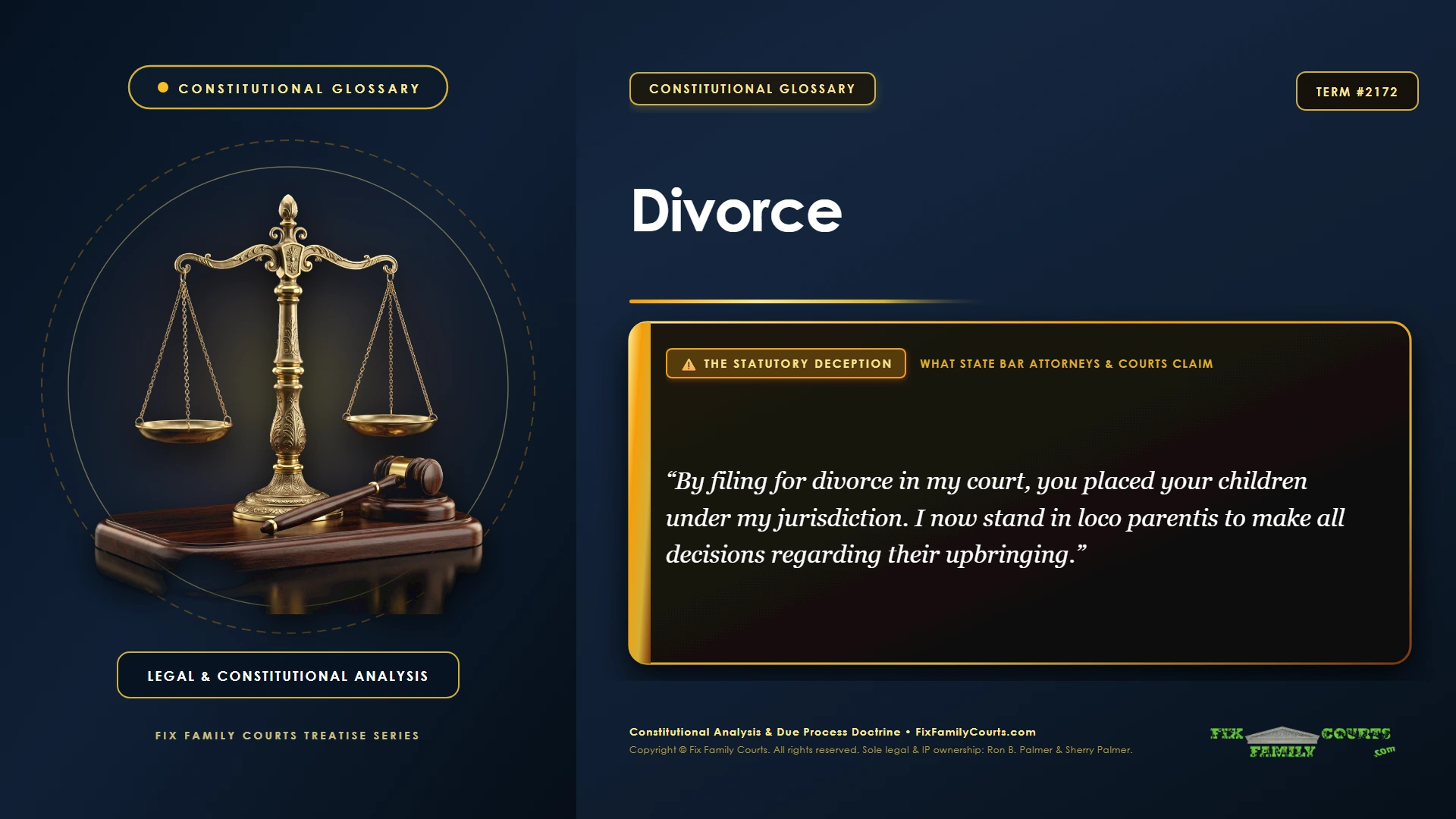
Family courts and lawyers routinely tell parents: "By filing for divorce in my court, you placed your children under my jurisdiction. I now stand in loco parentis to make all decisions regarding their upbringing."
This assertion is a total usurpation of power. Filing for divorce asks the court to dissolve a civil legal contract between spouses. It does NOT surrender natural parental rights to the state.
The Strict Firewall Between Marriage Dissolution and Parental Liberty
Divorce is the legal dissolution of a marital partnership. Under the First and Fourteenth Amendments, marriage is a private association. The freedom of intimate association encompasses the absolute freedom to end that marital relationship when consent dissolves.
Children are not chattel, marital assets, or property to be divided upon divorce. Each parent's constitutional relationship with their child is an individual, non-delegable fundamental right that exists completely independent of the marriage. The end of the spousal contract leaves both parents in exactly the same position they occupied prior to filing: fit legal custodians protected equally by the Constitution.
Due Process Right to Dissolve Marital Ties
“Marriage involves interests of basic importance in our society; access to the judicial process to dissolve that relationship cannot be blocked by state barriers.”
As ruled by the Supreme Court in 1971, access to the judicial process to dissolve a marriage is a constitutionally protected due process right. The state cannot erect unconstitutional barriers or force parents into commercial litigation traps as a condition of restoring their individual legal status.
Decoupling Contract From Natural Rights
The court's subject-matter jurisdiction in divorce extends to dissolving the legal entity of marriage and adjudicating marital property.
Subject-matter jurisdiction over marital status does not grant dispositional authority to abridge fundamental Fourteenth Amendment liberties without proven unfitness.
The "Consolidated SAPCR" Trap
State codes deliberately combine suit for divorce with suits affecting the parent-child relationship (SAPCR) into a single proceeding.
By lumping property division, spousal alimony, and child custody into one adversarial war, state statutes incentivize bitter conflict.
Sever the issues. The court has jurisdiction over the marital contract, but lacks dispositional jurisdiction to ration custody between fit parents absent proven unfitness.
How to Assert the Jurisdictional Firewall in Divorce
When a divorce court attempts to exercise plenary custody powers:
"Formal Jurisdictional Objection: I object to the Court asserting dispositional custody jurisdiction over the minor children as an incident of this marital dissolution proceeding."
"Dissolution of the marriage terminates only the spousal legal entity. It does not confer jurisdiction upon this Court to strip or reallocate individual Fourteenth Amendment parental liberties between fit parents. Both parents remain equally protected by the Constitution as a matter of law."