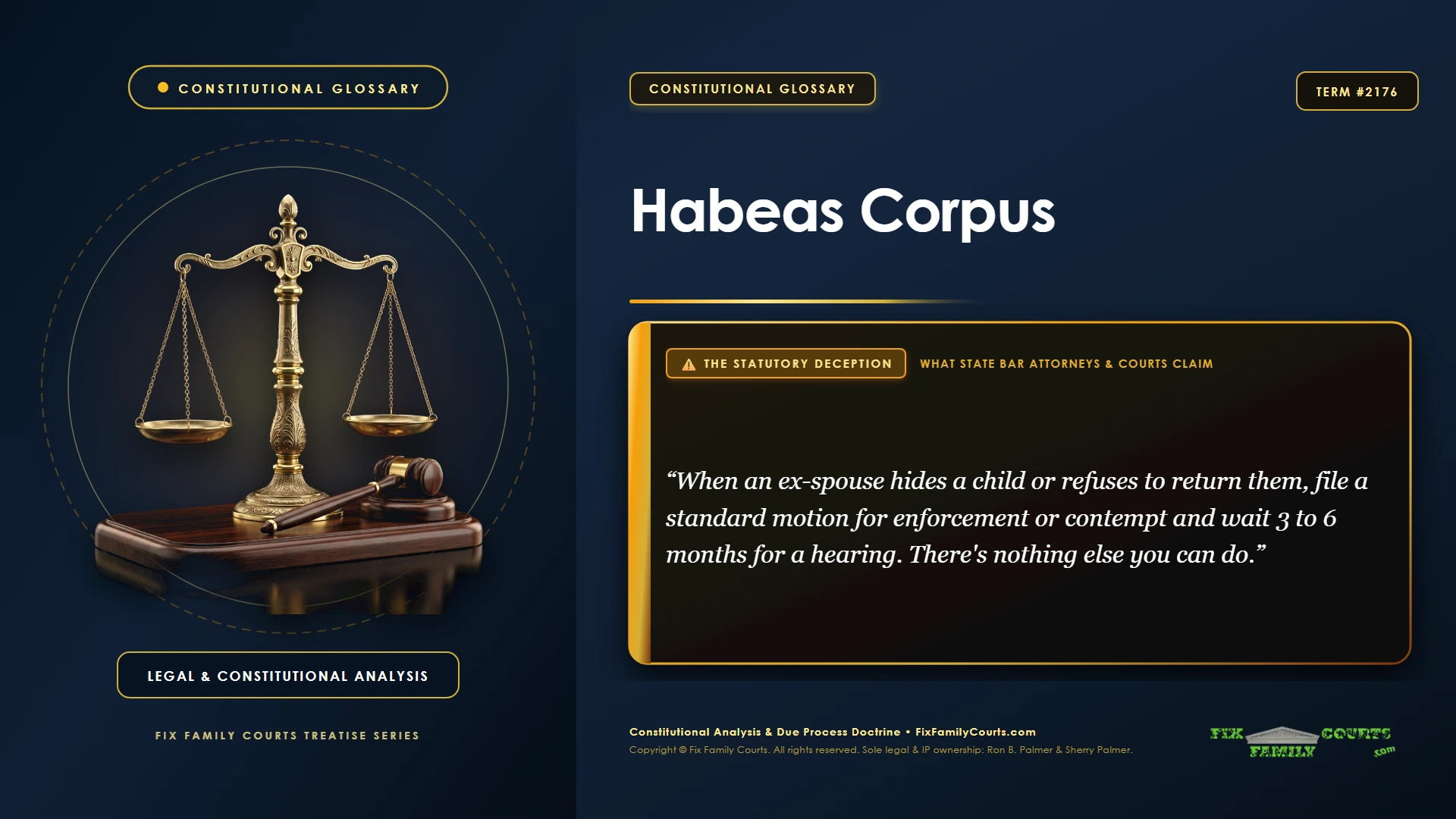
Habeas Corpus
How to deploy the Great Writ to rapidly challenge unlawful child restraint and void custody orders entered without subject-matter jurisdiction.
What Family Lawyers Tell Deprived Parents
Family courts and lawyers routinely tell parents: "When an ex-spouse hides a child or refuses to return them, file a standard motion for enforcement or contempt and wait 3 to 6 months for a hearing. There's nothing else you can do."
This advice ignores the most potent emergency weapon in common law. Waiting months allows parental alienation and status quo arguments to take root, while a Writ of Habeas Corpus demands immediate production of the child.
The Dual Application of Habeas Corpus in Custody
Habeas Corpus ("that you have the body") is the ancient Anglo-American writ protecting bodily liberty against unlawful restraint. In child custody litigation, it possesses two vital applications: enforcing legal custody against physical concealment, and challenging void orders entered without jurisdiction.
When one parent unlawfully conceals or withholds a child in violation of an existing decree, a Petition for Writ of Habeas Corpus compels the respondent to physically bring the child before the bench immediately, without waiting for the general civil docket.
The Privilege of the Writ Cannot Be Suspended
“The Privilege of the Writ of Habeas Corpus shall not be suspended, unless when in Cases of Rebellion or Invasion the public Safety may require it.”
The Writ of Habeas Corpus is explicitly safeguarded in the text of the United States Constitution. State family codes recognize habeas proceedings as priority matters requiring immediate issuance of a writ commanding the immediate return of the child.
Challenging Void Orders Issued Ultra Vires
Where a family court enters an order seizing or reallocating custody without personal jurisdiction, subject-matter jurisdiction, or notice, the resulting order is void ab initio.
Habeas corpus operates as a direct collateral challenge to restore liberty when physical restraint is executed under the color of a void judicial order.
The "Enforcement Motion" Delay Trap
Filing a sluggish motion for contempt gives the withholding parent months to manufacture false allegations and alienate the child from your affection.
By the time the hearing arrives 90 days later, the judge says: "The child has adapted to this new schedule, so we will keep it temporarily."
File a Petition for Writ of Habeas Corpus with a Writ of Attachment, commanding the sheriff to retrieve the child and produce them in court.
How to Demand Immediate Return of the Child
In open court upon presentation of your Petition for Writ of Habeas Corpus, state:
"Formal Motion for Immediate Return: Petitioner moves for an immediate order directing the return of the child pursuant to the verified Petition for Writ of Habeas Corpus."
"Petitioner has established an unassailable legal right to possession under the controlling decree. Habeas corpus is a summary proceeding that does not permit cross-claims or modification hearings. I move for the immediate ministerial entry of an order restoring physical possession."