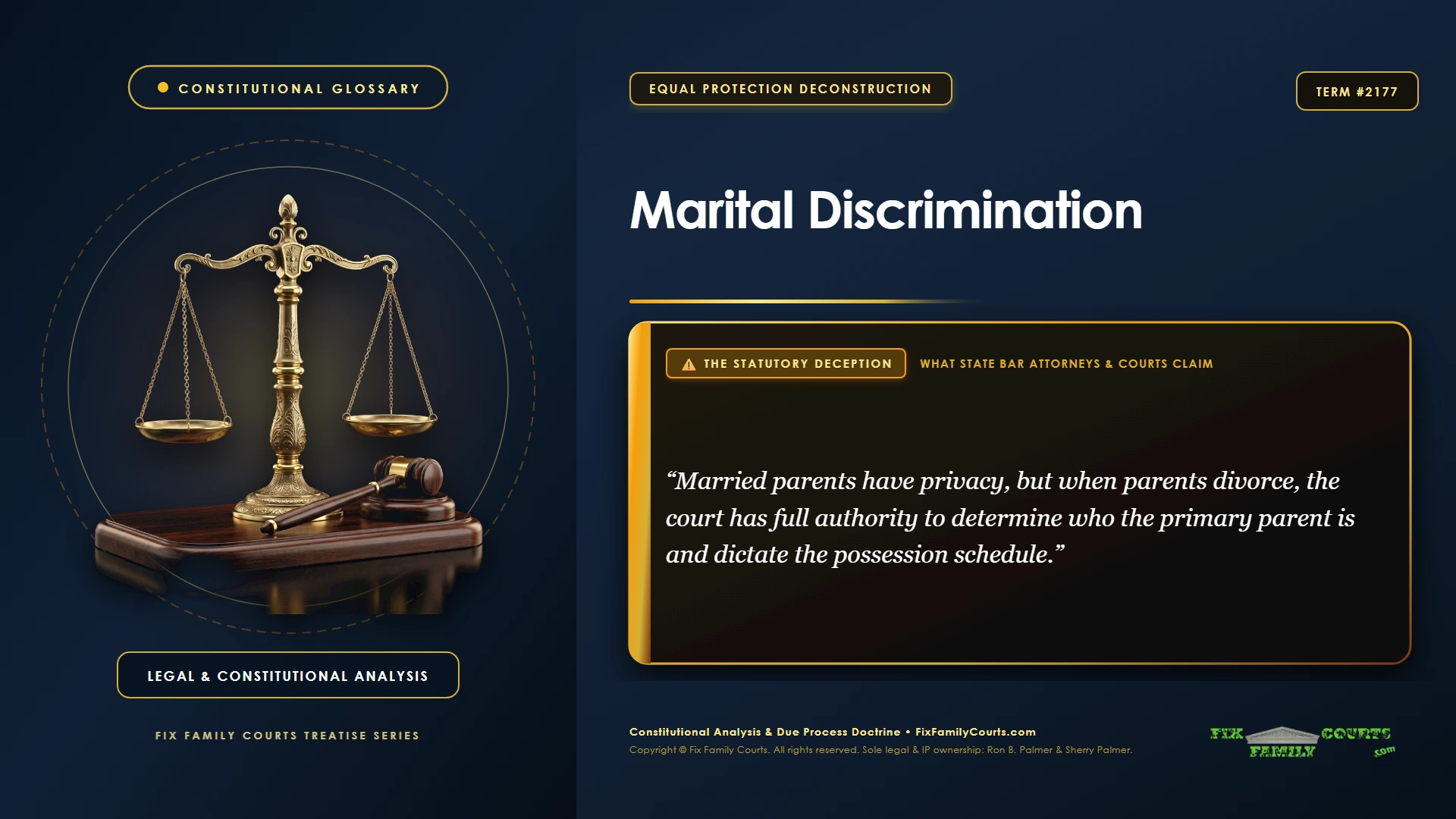
Marital Discrimination
How state family courts unconstitutionally degrade divorced and unmarried fit parents into second-class citizens in direct violation of the Equal Protection Clause.
The Two-Tiered System of Parental Rights
Family courts and lawyers routinely tell parents: "Married parents have privacy, but when parents divorce, the court has full authority to determine who the primary parent is and dictate the possession schedule."
This distinction is pure marital discrimination. The Constitution strictly bars government actors from conditioning fundamental rights upon a citizen's marital status.
The Supreme Court's Landmark Ban on Marital Status Penalties
In the 1960s and 1970s, state statutes routinely discriminated against children and parents based upon marital status under historical "Bastardy" laws. In a historic series of decisions, the United States Supreme Court struck down these statutes as intolerable violations of the Equal Protection Clause.
Modern family courts commit the exact same constitutional violation in reverse. They penalize parents who exercise their First Amendment right to disassociate from a marriage by stripping them of their natural 50/50 parental baseline and reducing one parent to an alternating-weekend visitor.
Familial Rights Do Not Depend Upon Marriage
“The status of being a parent is no less deserving of protection whether the relationship was forged within or outside the bonds of marriage.”
As ruled by the Supreme Court in 1972, the state cannot treat unmarried or divorced parents as inferior legal actors. Parental fitness, not marital status, is the sole constitutional metric.
Strict Prohibition of Marital Status Classifications
The Supreme Court repeatedly held that penalizing individuals or children based on marital status bears no rational relationship to legitimate state interests.
State family courts cannot resurrect unconstitutional discrimination by creating unequal custody classes based on marital dissolution.
The "Primary Caregiver" Pretext Trap
Family courts frequently use the pretext of "who took the child to the doctor during the marriage" to create an unequal division post-divorce.
Dividing parental duties during a collaborative marriage was never an agreement to surrender parental rights upon divorce.
Demand equal custody as the default constitutional baseline, requiring the state to treat both fit natural parents equally under the law.
How to Assert Equal Protection Against Marital Penalties
When the court proposes an unequal custody division between two fit parents:
"Formal Equal Protection Objection: I object to any order that divides custody unequally between two fit legal parents as an unconstitutional violation of the Equal Protection Clause of the Fourteenth Amendment."
"Under established Supreme Court precedent, the state cannot impose legal penalties or second-class status upon fit parents based on their marital or non-marital status. Absent an adjudicated compelling state interest achieved by the least restrictive means, similarly situated fit parents are entitled to equal treatment and equal physical custody under the law."