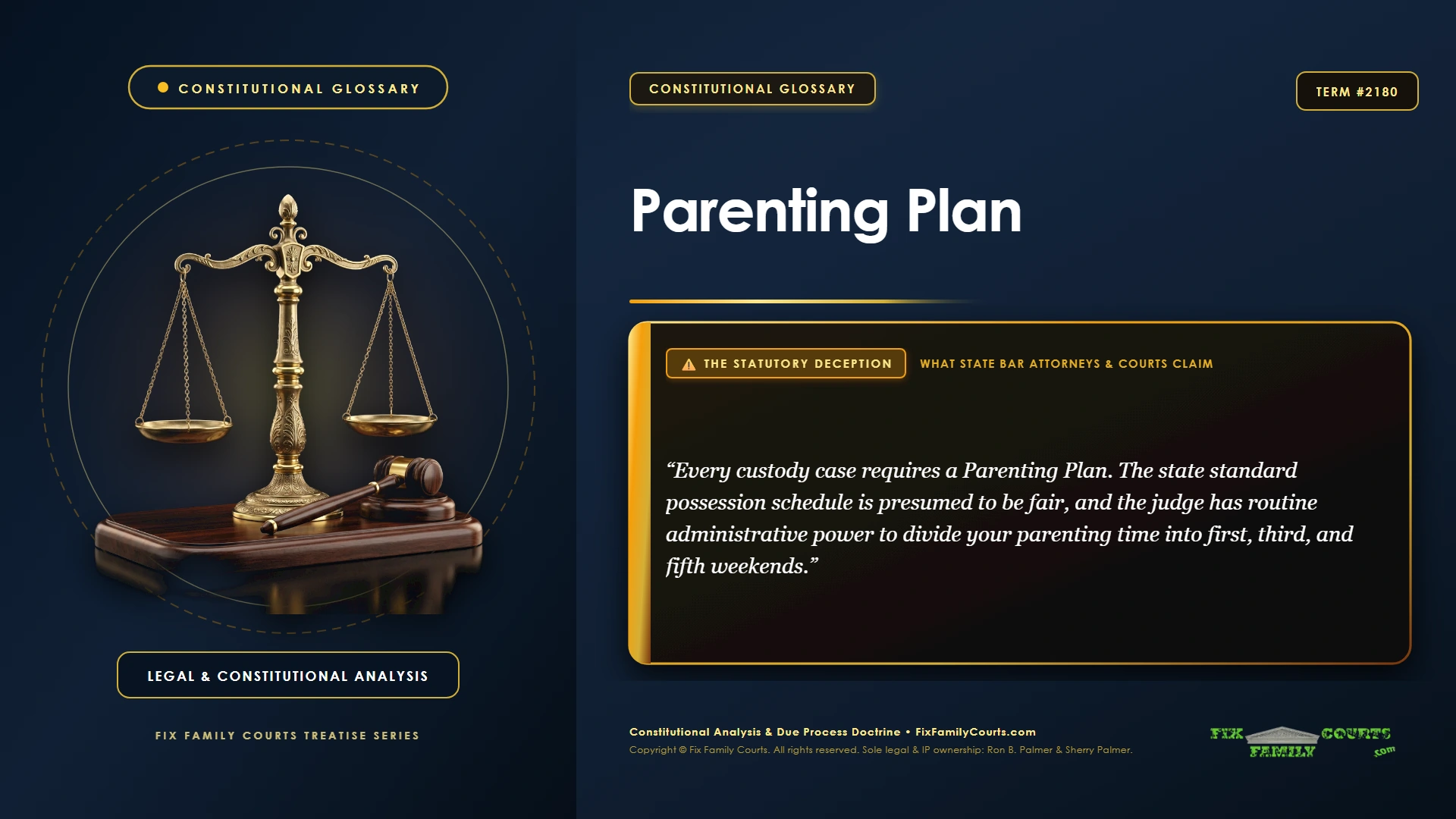
Parenting Plan
How state standard possession orders operate as unconstitutional prior restraints and advance licensing schemes upon fundamental familial association.
What Family Courts & State Bar Attorneys Claim
Family courts and lawyers routinely tell parents: "Every custody case requires a Parenting Plan. The state standard possession schedule is presumed to be fair, and the judge has routine administrative power to divide your parenting time into first, third, and fifth weekends."
This portrays an invasive prior restraint as a benevolent administrative scheduling tool, concealing that imposing a calendar-based restriction on fit parents is a direct constitutional infringement.
Parenting Plans as Unconstitutional Prior Restraints
In constitutional law, an order that restricts a citizen's right to speak, assemble, associate, or practice their religious and moral conscience before the act occurs is classified as a Prior Restraint.
When a state family court imposes a standardized "Parenting Plan" dividing a fit parent's natural custody into rigid time blocks, it operates as a judicial licensing regime. It decrees that a fit mother or father has zero lawful right to speak to, hug, mentor, teach, or comfort their child except during state-sanctioned hours.
Prior Restraints Face a Heavy Presumption of Unconstitutionality
“Any system of prior restraints of expression comes to this Court bearing a heavy presumption against its constitutional validity.”
As established by the United States Supreme Court in landmark First Amendment jurisprudence, the government cannot place advance bans on fundamental protected expression and assembly. Intimate familial association between a fit parent and child is speech, assembly, and exercise of conscience at its highest zenith. Imposing possession schedules without strict scrutiny violates this foundational guarantee.
State Encroachment Requires Proof of Harm
Under the Supreme Court's definitive parental rights rulings, fit parents are presumed to act in the best interests of their children. The state has zero compelling interest in dictating the daily calendar of two fit legal parents who simply no longer reside together.
Converting a divorce into ongoing judicial micromanagement of meals, bedtimes, travel, and holidays constitutes state overbreadth that strips families of their fundamental right to privacy.
The "Standard Possession Consent" Trap
Attorneys frequently advise clients to accept a temporary parenting plan "just to establish a baseline." This is procedural surrender.
Once you agree to an unconstitutional temporary possession schedule, courts lock it in as the status quo and later argue that changing it disrupts child stability.
Object on the record to any parenting plan that functions as a prior restraint on your association without an adjudicated finding of unfitness under strict scrutiny.
How to Challenge a Parenting Plan as a Prior Restraint
When ordered to submit to a restrictive statutory possession schedule, preserve your objection with this formal statement:
"Formal Constitutional Objection: I object to the imposition of any statutory parenting schedule that operates as an unconstitutional prior restraint upon my fundamental right to speak, assemble, and freely associate with my child."
"Under controlling Supreme Court precedent, prior restraints on fundamental association bear a heavy presumption of unconstitutionality. Absent an adjudicated finding of parental unfitness or demonstrable clear and convincing harm under strict scrutiny, the Court lacks constitutional authority to license or ration my parental association."