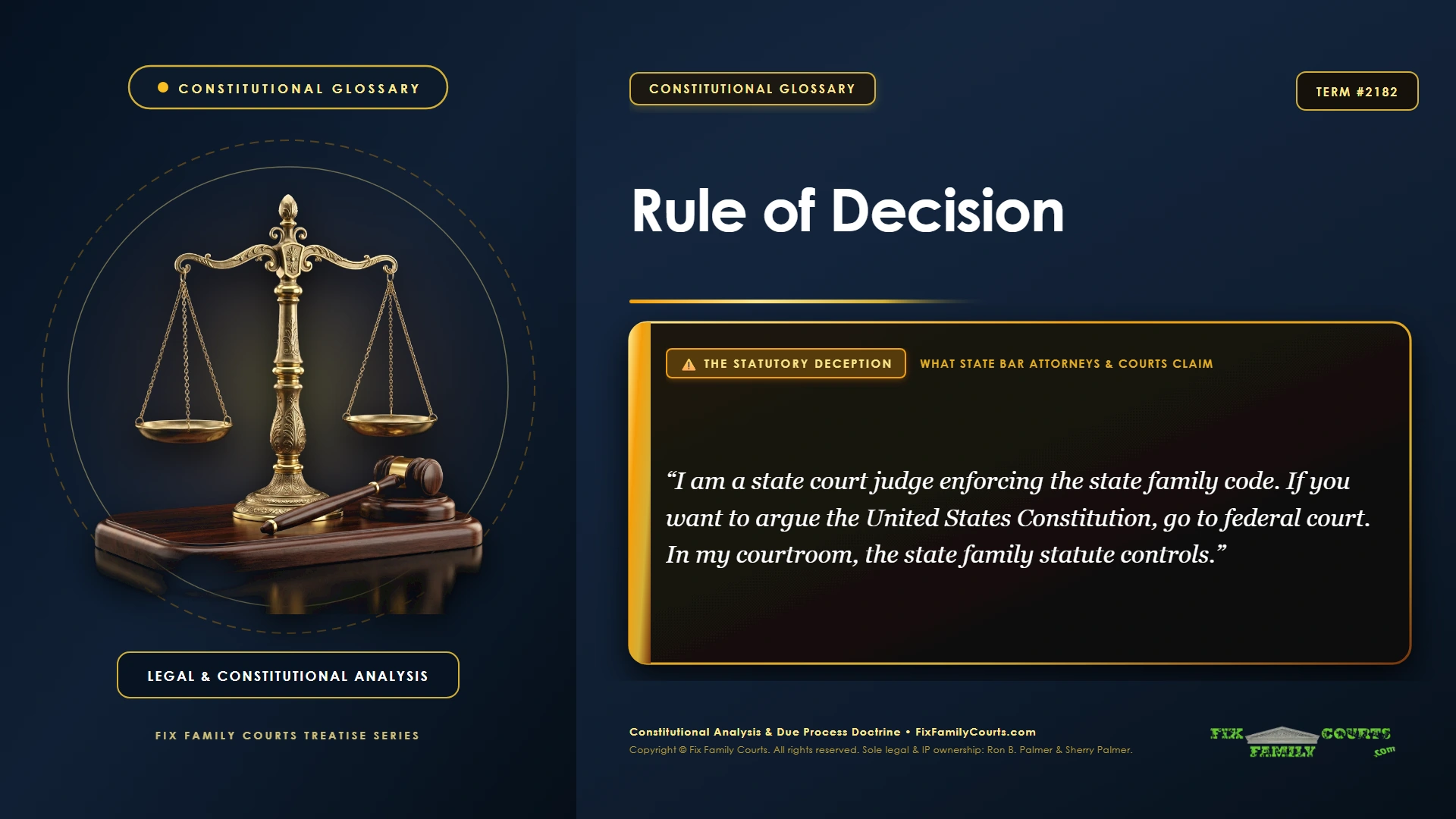
Rule of Decision
How Article VI and the Rules of Decision Act compel every state family court judge to enforce the U.S. Constitution above conflicting local family statutes.
What State Court Judges Tell Litigants
Family courts and lawyers routinely tell parents: "I am a state court judge enforcing the state family code. If you want to argue the United States Constitution, go to federal court. In my courtroom, the state family statute controls."
This statement violates the judge's solemn oath of office. The Supremacy Clause explicitly binds every state judge to enforce federal constitutional law above conflicting state statutes.
The Constitution as the Supreme Rule of Decision
A Rule of Decision is the controlling legal authority that dictates how a judicial tribunal must decide a controversy, stripping the decision-maker of arbitrary personal choice.
Under Article VI, Clause 2 of the United States Constitution (the Supremacy Clause): "This Constitution, and the Laws of the United States which shall be made in Pursuance thereof... shall be the supreme Law of the Land; and the Judges in every State shall be bound thereby, any Thing in the Constitution or Laws of any State to the Contrary notwithstanding."
A Law Repugnant to the Constitution is Void
“A Law repugnant to the Constitution is void... Courts, as well as other departments, are bound by that instrument.”
As ruled by Chief Justice John Marshall in 1803, whenever a state family court statute conflicts with the Fourteenth Amendment guarantee of parental liberty, the state statute must yield. State judges have a mandatory constitutional duty to apply the Constitution as their supreme rule of decision.
The Rules of Decision Act
The laws of the several states shall be regarded as rules of decision except where the Constitution, treaties, or statutes of the United States otherwise require.
Where state family statutes conflict with federal due process and equal protection guarantees, federal constitutional law controls absolutely.
The "Local Rules" Diversion Trap
Local courts frequently enforce county standing orders and local rules that conflict directly with constitutional due process.
Allowing the trial judge to dismiss federal constitutional arguments by citing local custom or administrative guidelines.
Formally demand that the court take judicial notice of Article VI, Clause 2 and apply the federal Constitution as the controlling rule of decision.
How to Invoke the Constitution as the Controlling Rule of Decision
State this formal motion when the trial court attempts to bypass constitutional protections:
"Formal Motion for Constitutional Rule of Decision: I move that this Court apply the United States Constitution and binding Supreme Court precedent as the controlling rule of decision in this proceeding."
"Pursuant to Article VI, Clause 2 of the United States Constitution and this Court's oath of office, federal constitutional guarantees supersede all conflicting state statutes, local rules, or administrative guidelines. To the extent any state family code provision permits the restriction of my parental liberty without satisfying strict scrutiny, it is unconstitutional as applied and must yield to the supreme law of the land."