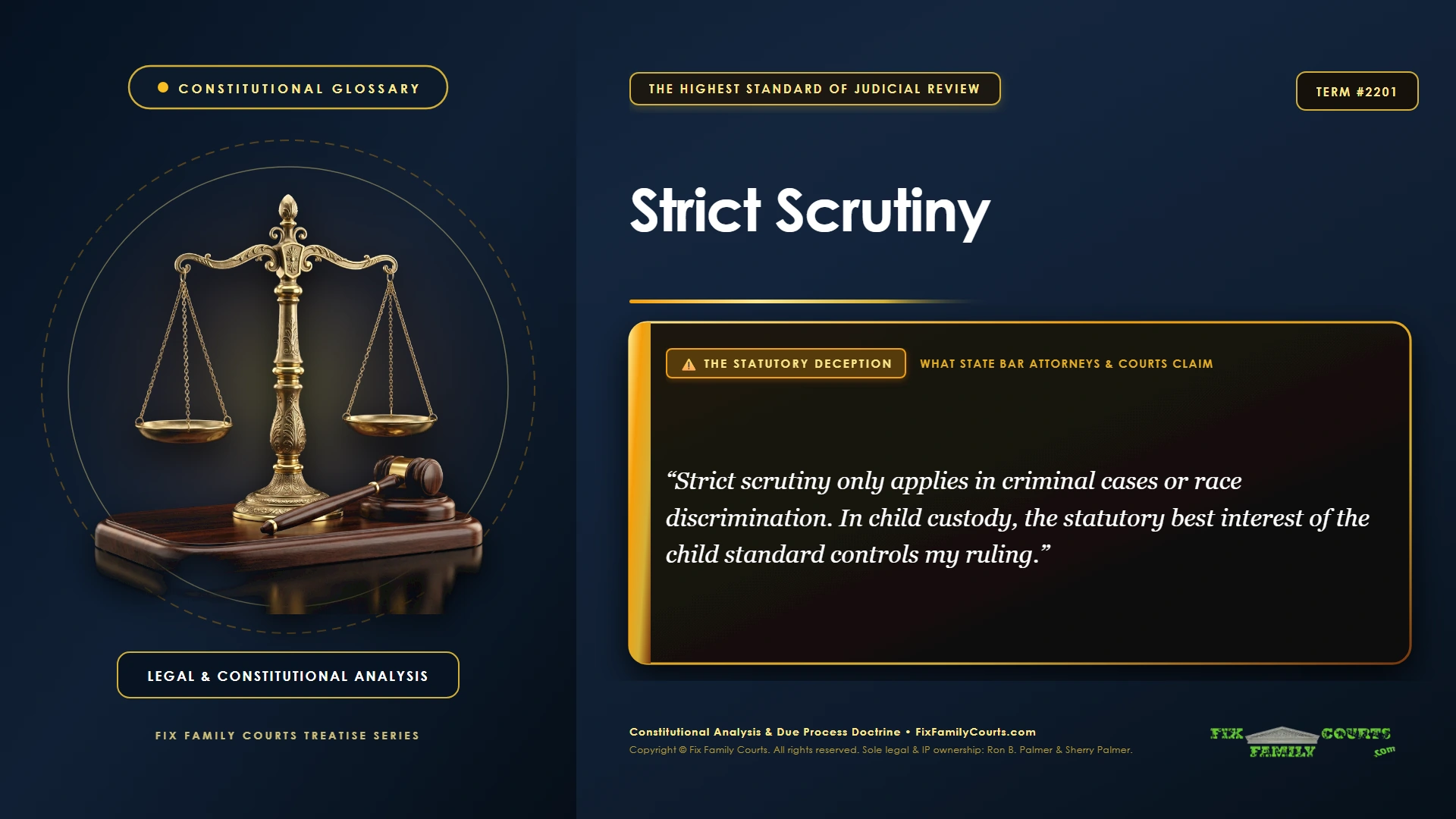
Strict Scrutiny
The most demanding constitutional standard in American law: why state family courts cannot infringe upon fit parents without proving a compelling state interest and narrow tailoring.
Substituting "Best Interest" for Strict Scrutiny
Family courts and lawyers routinely tell parents: "Strict scrutiny only applies in criminal cases or race discrimination. In child custody, the statutory best interest of the child standard controls my ruling."
This statement is a total legal fallacy. Under uniform Supreme Court precedent, whenever ANY state action infringes upon a fundamental constitutional right, Strict Scrutiny is automatically triggered as a mandatory matter of constitutional law.
The Two Inflexible Prongs of Strict Scrutiny
Strict Scrutiny is the highest, most exacting standard of judicial review in Anglo-American constitutional law. To survive strict scrutiny, the government actor must affirmatively prove two mandatory elements on the record: (1) a compelling state interest, and (2) the least restrictive means possible.
The state must prove an interest of the highest order—specifically, preventing actual severe physical harm or adjudicated parental unfitness. Generalized "welfare" or subjective "best interest" is legally insufficient. Even if harm is shown, the state must employ the least restrictive intrusion possible.
Parental Rights Are Fundamental Liberty Interests
“The interest of parents in the care, custody and control of their children is perhaps the oldest of the fundamental liberty interests recognized by this Court.”
Because parental rights are fundamental liberty interests, state courts are legally barred from applying mere "rational basis" or discretionary "best interest" balancing tests. Strict Scrutiny is the only constitutional standard that can lawfully support state interference.
Clear and Convincing Evidence Standard
Infringement upon fundamental liberty interests requires an elevated evidentiary standard—clear and convincing evidence—not a mere preponderance.
A family judge cannot reallocate custody between fit parents under a relaxed preponderance of evidence standard.
The "Statutory Deference" Waiver Trap
When parents fail to demand strict scrutiny findings on the record, trial courts default to unreviewable "abuse of discretion" standards.
Appellate courts affirm almost any ruling under "judicial discretion," making appeals virtually impossible to win.
The burden shifts entirely to the state to prove severe harm by clear and convincing evidence, locking in a winning standard on appeal.
How to Demand Strict Scrutiny Findings on the Record
State this formal constitutional objection before the court enters any order altering parental rights:
"Formal Constitutional Motion for Strict Scrutiny: I move that this Court apply the Strict Scrutiny standard of judicial review before entering any order that infringes upon, restricts, or reallocates my fundamental parental rights."
"Under binding Supreme Court precedent, parental rights are fundamental liberty interests protected by the Fourteenth Amendment. The state cannot burden fundamental liberties through discretionary statutory balancing tests. I demand that the Court make explicit findings on the record demonstrating: (1) a compelling state interest proved by clear and convincing evidence, and (2) that the proposed order represents the least restrictive means possible."