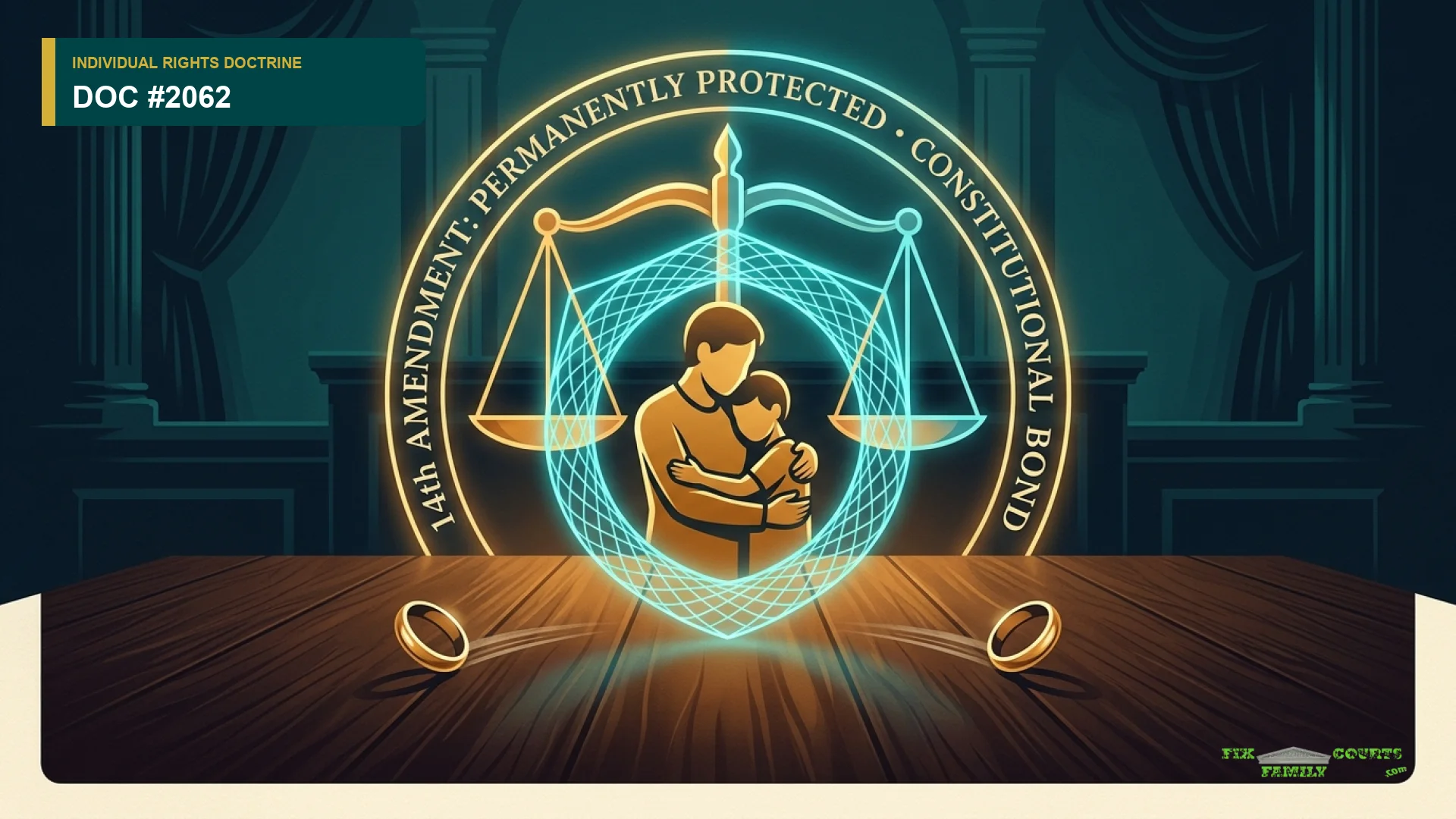
Overview: Rights are NOT Dependent on Marriage
If your rights are not attached to the marriage or the other parent then how can they use divorce to deprive you of your parental rights, the money that you use to raise your child with, and your future earnings? This is another peek at what we are teaching the parents taking our class teaching them about their rights and how to get better results. This segment only talks about your parental rights. We have other class lectures that cover child support and alimony issues that parents face today. Contact us for more information on any of these classes: info@fixfamilycourts.com
The book that Ron wrote and is teaching the class from goes into more detail on how to protect those rights. If you are interested in taking the class next round please let us know at info@fixfamilycourts.com and visit more of our posts at www.fixfamilycourts.com. Get the book here: http:__wp.me_P3SVT1-cB
In standard family court litigation, fit parents are routinely told that trial judges have unbounded discretion to divide custody and assign possession schedules. However, controlling Supreme Court jurisprudence strictly establishes that natural parental rights cannot be denied, stripped, or nullified without proving unfitness under strict scrutiny. Understanding these core constitutional protections empowers parents to hold attorneys and trial judges accountable to the law.
Executive Summary & Key Takeaways
- ✓ Exposes the procedural and constitutional defects in standard family court custody proceedings.
- ✓ Explains why fundamental parental rights are protected under the Fourteenth Amendment Due Process Clause.
- ✓ Equips parents with actionable legal arguments to counter judicial overreach and preserve the record for appeal.
Key Topics & Video Timestamps
Navigate directly to specific topics, arguments, and strategic insights covered in this presentation (1 indexed chapters):
Full Presentation: Rights are NOT Dependent on Marriage
Complete presentation (04:17) covering core parental rights and strategic legal arguments.
Constitutional Principles & Controlling Precedents
This presentation directly implicates fundamental constitutional guarantees and controlling appellate precedents:
Cited Judicial Precedents
Constitutional Protections Invoked
Full Video Transcript
hi today we're here to do a quick introduction for chapter seven and8 of our book not in the child's best interest these are interesting chapters because they get into some of the meat of the issues that we face as parents particularly in divorce chapter 7 gets into the details of why these rights are individual rights in nature and that your parental rights are not tied to the marriage parental rights are individual in nature each parent and each child regardless of marriage a lot of the bias and the Prejudice and the bigotry we see exhibited towards divorced parents is left over from these hundreds and thousands of years where we had these really absurd inheritance laws and this
idea of bastard children that simply had no rights and couldn't inherit and there was a lot of social stigma and Prejudice that went along with that and it wasn't until the mid to late '70s that they this really got wrapped up and an end was put to it and even post 70s there was still stigma around divorce divorcing parents and divorcing children and that stigma was carried over and that's one of the reasons why parents and divorce are treated as second class citizens divorce affects the marriage divorce is about separating two married parents and making them single parents but your parental rights have no relationship whatsoever to the marriage so if that's the case how do divorce
courts who are overseeing a separation of married parents and the single parents how do they justify intervention into custody issues they really have no entry point into this issue whatsoever your rights are individual each parent has them fully and completely and the only thing that divorce changes is is that you no longer agree on how you're going to raise your children and who is going to be able to exercise those rights at any given time so essentially any state statute out there that treats divorcing parents differently than married parents that uses the divorce process as a trigger to deprive you of your fundamental liberty interest any state statute that does that is most likely unconstitutional and
should absolutely be challenged so one of the things you have to be careful for in these State statutes is the states have gotten rather tricky in how they make people believe that they continue to have rights even after divorce and they have this thing called joint custody many states have it now and they say well instead of one parent having soulle custody and the other parent being just a visitor both of you have joint custody and so you both have equal rights but the reality is you don't have equ equal rights in Texas they start spelling out your rights in the orders and say this parent has this right that parent has that right and they reduce
your rights at will so joint custody is a myth it's really a Flatout lie so keep in mind that a lot of what these state laws set up and they use a lot of language that makes us think we're getting treated equally and if you really dig into it and look at it they're flat outlining to you so the bottom line with chapter 8 is that all fit parents must be treated equally under the law they cannot discriminate against parents in divorce and comply with the equal protection Clause of the [Music] [Music]