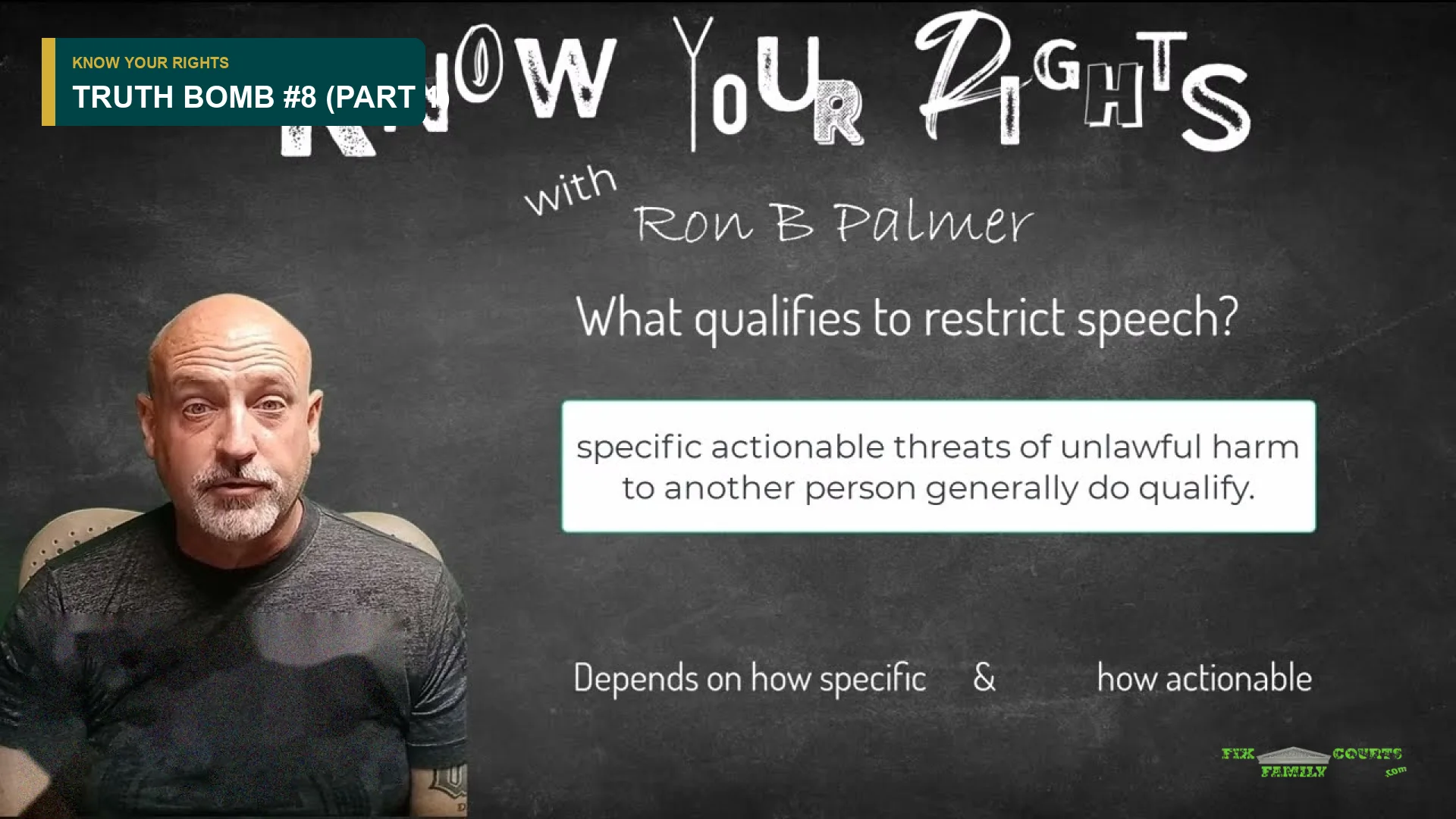
Overview: Truth Bomb 8 Part 1: Parenting plans are prior restraints
This video introduces parents to prior restraints in family law child custody battles. Prior restraints is a serious concern as it is the root of how a judge ignoring fundamental rights in divorce cases between two fit parents harms your child.
Topics covered in this video: What is a prior restraint? What standard is used? When can a court restrict speech? Gag Orders.
In standard family court litigation, fit parents are routinely told that trial judges have unbounded discretion to divide custody and assign possession schedules. However, controlling Supreme Court jurisprudence strictly establishes that natural parental rights cannot be denied, stripped, or nullified without proving unfitness under strict scrutiny. Understanding these core constitutional protections empowers parents to hold attorneys and trial judges accountable to the law.
Executive Summary & Key Takeaways
- ✓ Exposes the procedural and constitutional defects in standard family court custody proceedings.
- ✓ Explains why fundamental parental rights are protected under the Fourteenth Amendment Due Process Clause.
- ✓ Equips parents with actionable legal arguments to counter judicial overreach and preserve the record for appeal.
Key Topics & Video Timestamps
Navigate directly to specific topics, arguments, and strategic insights covered in this presentation (1 indexed chapters):
Full Presentation: Truth Bomb 8 Part 1: Parenting plans are prior restraints
Complete presentation (04:53) covering core parental rights and strategic legal arguments.
Constitutional Principles & Controlling Precedents
This presentation directly implicates fundamental constitutional guarantees and controlling appellate precedents:
Cited Judicial Precedents
Constitutional Protections Invoked
Companion Article First Amendment Truth Bomb #8: Prior Restraints on Speech Read Written Guide ↓ Hide Written Guide ↑ ▼
First Amendment Truth Bomb #8: Prior Restraints on Speech
Introduction
In the realm of constitutional rights, the First Amendment stands as a cornerstone, safeguarding freedom of speech and expression. However, this freedom is not absolute. One area where the government's power to regulate speech comes into sharp focus is through what are known as prior restraints. This article delves into the concept of prior restraints, particularly in the context of family courts, and how they intersect with First Amendment rights.
Understanding Prior Restraints
Definition and Scope
A prior restraint is a government restriction on speech or expression before it takes place. This means the government is attempting to control what can be said or expressed before the communication even occurs. Such restraints are viewed with a high degree of skepticism under First Amendment jurisprudence.
Prior Restraints in Family Courts
In family court settings, prior restraints can manifest in various ways. A common example is when a judge orders a parent not to share information about their case with their child or restricts the language a parent can use when speaking to their child. These orders are often intended to protect the child from the stress or emotional harm that might arise from exposure to the details of a custody battle.
Gag Orders as Prior Restraints
Another form of prior restraint is a gag order, which is an order that restricts speech or expression before it happens. Gag orders are generally considered prior restraints and are subject to strict scrutiny.
The First Amendment and Prior Restraints
General Unconstitutionality
Prior restraints are generally considered unconstitutional unless the government can meet very strict standards. This is because they are seen as a direct infringement on the freedom of speech.
Time, Place, and Manner Restrictions
There are exceptions to the general rule against prior restraints. The government can impose restrictions on the time, place, or manner of expression, provided these restrictions are not based on the content of the expression. For example, a city might require permits for protests to manage traffic flow, but it cannot deny a permit based on the protest's message.
Intermediate Scrutiny
When a prior restraint is based on the time, place, or manner of expression and not on the content, it is subject to intermediate scrutiny. This means the government must show that the restriction is narrowly tailored to serve a significant government interest and leaves open ample alternative channels for communication.
Content-Based Restrictions
Higher Standard of Review
The standard of review becomes much stricter when the government restricts speech based on its content. In such cases, the government must demonstrate that the restriction is necessary to serve a compelling state interest and is narrowly drawn to achieve that end. This is known as strict scrutiny.
Hate Speech
The fact that speech or expression may be hateful does not, by itself, justify limiting it. The First Amendment protects even offensive or unpopular views, as long as they do not cross the line into unprotected speech, such as incitement to violence or true threats.
Actionable Threats
Specific, actionable threats of unlawful harm to another person are generally not protected by the First Amendment. However, the threat must be specific and credible enough to cause a reasonable person to fear for their safety or the safety of others.
Challenging Prior Restraints in Family Court
Content-Based Prior Restraints in Custody Cases
When a judge orders a parent not to speak to their child about a child custody case, it is often a content-based prior restraint. The judge is presuming that talking to the child about the case would be harmful and that the court has the authority to prevent this type of harm.
Raising Objections
If you believe a court order constitutes an unlawful prior restraint, it is crucial to raise an objection, both orally during hearings and in writing afterward. This objection should clearly state that the order infringes on your First Amendment rights.
Conclusion
Prior restraints on speech are a sensitive area of constitutional law, particularly when they arise in the context of family court proceedings. While courts have a legitimate interest in protecting children from harm, restrictions on speech must be carefully scrutinized to ensure they do not unduly infringe on fundamental First Amendment rights. Understanding the principles governing prior restraints can empower individuals to advocate for their rights and ensure that court orders are consistent with constitutional protections.
Full Video Transcript
hi I'm Ron Palmer from fixed family courts and I'm here to explain our our first amendment truth bomb number eight to you and this truth bomb is an extremely powerful tool that you can apply simply by raising objection both orally in your hearings and in writing after your hearings so our first amendment truth bomb reads the First Amendment especially protects against what are called prior restraints on your speech such as when your judge orders that you cannot share information about your case with your child or use certain words with your child so a prior restraint is where the government restricts speech or expression before it happens when a court tells you that you cannot speak to
your child about your child custody case your judge is issuing a prior restraint when a judge issues an order that restricts speech or expression before it happens it is generally termed a gag order but gag orders are prior restraints I object to this injunction that you have placed on both of us to control the speech and expression with my child it is a form of preventive law that is infringing on my civil liberties to share my ideologies and raise my child how I see fit it is a control device for not as a punishment for actual wrongful conduct but with a view to preventing which you're assuming is a future Evil by implementing the series of
restrictions in this injunction this Mutual restraining order injunction and it seriously jeopardizing my freedom of expression with my child which is extremely important to passing on ideas and information that will help my child make decisions as my child ages PR restraints are generally unconstitutional unless the government government meets certain very strict standards when the government provides exclusive access to a government venue for a person or a group to speak the government prevents anyone else from using the venue at the same time this is a prior strength however so long as the restraint is on the time the place or the manner of the expression and the restraint is not based on the content of
the expression then intermediate scrutiny is the Constitutional standard this type of prior restraint is routine and not a problem generally so long as the government sticks to the rules the thing that raises the standard is when the government restricts speech based on the content of the speech we've had Nazi and Klux Clan marches in this country that were protected by police precisely because the first amendment does not permit the government to prevent speech or expression based on the content of that speech unless except in very very limited situations the fact that speech or expression may be hateful simply doesn't qualify to have it limited by the government however specific actionable threats of unlawful harm to another
person generally do qualify depending on how specific and how actionable the threat is so General statements of of of bad things is not going to get you in trouble usually you have to be it has to be pretty specific and actionable something that the other party is going to take notice of and think is real and credible so when your judge orders you not to speak to your child about your child custody case your judge is issuing a content-based prior restraint that is most likely unlawful in most cases because your judge is presuming that talking to your child about your case would be harmful to your child and your judge is presuming that he or she has
authority to prevent this type of harm [Music]