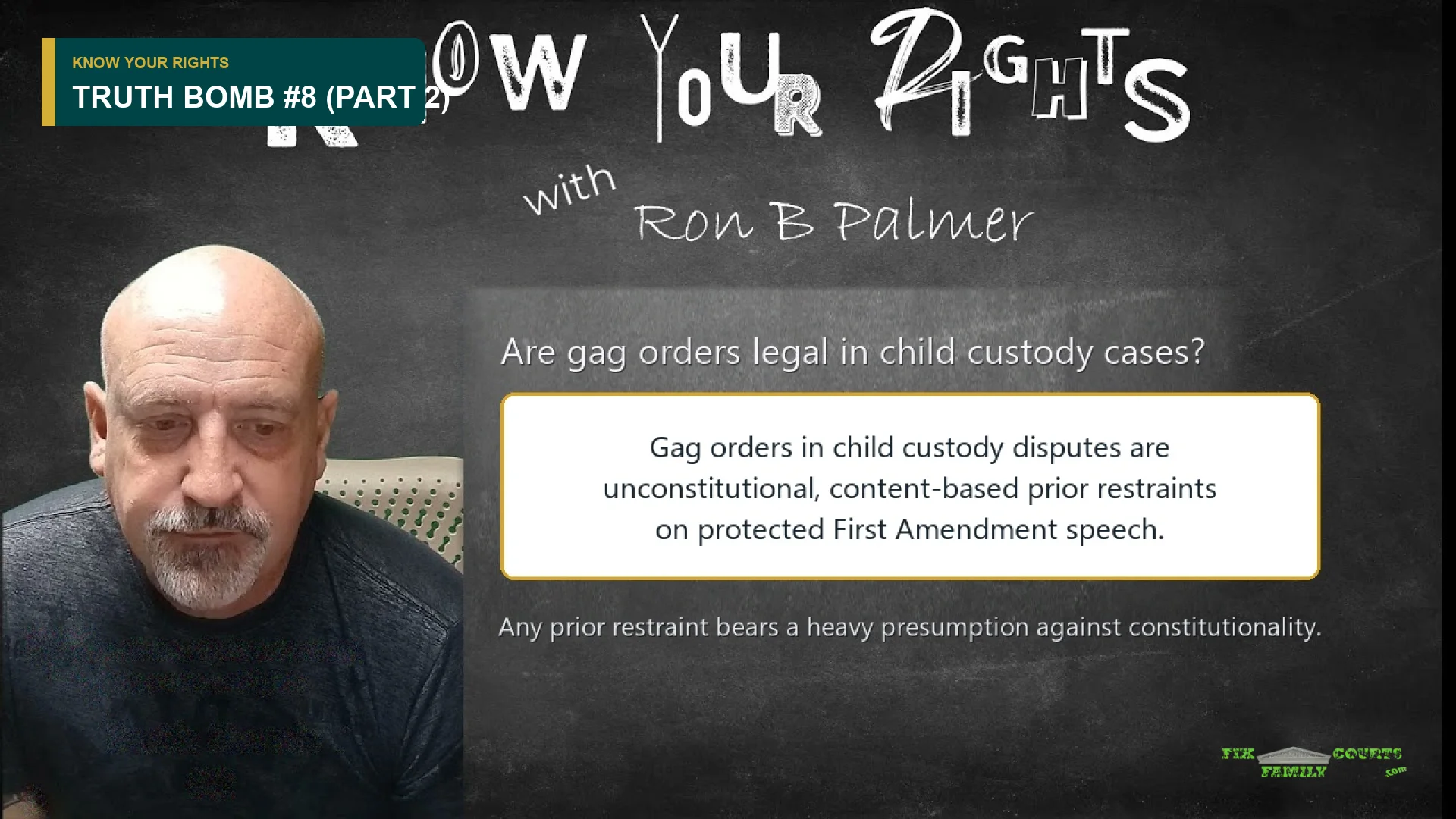
Overview: Truth Bomb 8 Part 2
This is the second half of prior restraints.
If you need more help with this information you can contact Ron at https://www.fixfamilycourts.com/about-us-pages/contact/
In standard family court litigation, fit parents are routinely told that trial judges have unbounded discretion to divide custody and assign possession schedules. However, controlling Supreme Court jurisprudence strictly establishes that natural parental rights cannot be denied, stripped, or nullified without proving unfitness under strict scrutiny. Understanding these core constitutional protections empowers parents to hold attorneys and trial judges accountable to the law.
Executive Summary & Key Takeaways
- ✓ Exposes the procedural and constitutional defects in standard family court custody proceedings.
- ✓ Explains why fundamental parental rights are protected under the Fourteenth Amendment Due Process Clause.
- ✓ Equips parents with actionable legal arguments to counter judicial overreach and preserve the record for appeal.
Key Topics & Video Timestamps
Navigate directly to specific topics, arguments, and strategic insights covered in this presentation (1 indexed chapters):
Full Presentation: Truth Bomb 8 Part 2
Complete presentation (09:00) covering core parental rights and strategic legal arguments.
Constitutional Principles & Controlling Precedents
This presentation directly implicates fundamental constitutional guarantees and controlling appellate precedents:
Cited Judicial Precedents
Constitutional Protections Invoked
Companion Article Understanding Content-Based Prior Restraints in Child Custody Cases Read Written Guide ↓ Hide Written Guide ↑ ▼
Understanding Content-Based Prior Restraints in Child Custody Cases
Introduction
When a judge orders you not to speak about your child custody case, they are issuing a content-based prior restraint. This is a legal term that refers to a judge's attempt to prevent you from speaking about certain topics related to your case. In most cases, such restraints are likely unconstitutional. This article will delve into the complexities of content-based prior restraints, particularly in the context of Best Interests of the Child justifications in family law, and explain why they are problematic.
Your judge's mere opinion regarding what is "best" in matters of conscience in child-rearing is a state "viewpoint," and Troxel refers to best interest as a mere difference of opinion. Any prior restraints on speech or association, such as a child custody order or parenting plan, that is justified by best interest is a viewpoint-based prior restraint. The United States Supreme Court has NEVER EVEN ONCE in its history ever permitted a viewpoint-based prior restraint to survive constitutional review.
If you ask the question properly and appropriately, even Google AI will explain to you how your child custody order is a prior restraint on speech and where authorized by statute, it is the state who must appear and prove, under the facts and context of your specific case, that the statute is constitutional, NOT you and NOT the other parent. If your judge argues the state's position against you, your judge disqualifies themself from being a judge in your case. Calling Best Interest a public policy can NOT save the judge where the policy is asserted by the judge against your rights.
What is a Content-Based Prior Restraint?
A content-based prior restraint occurs when a judge presumes that talking to your child about your case would be harmful and assumes the authority to prevent this type of harm. Both presumptions are extremely problematic. If you could challenge these prior restraints before an honest, neutral, and impartial judge, you would likely win. However, finding such a judge in family law is often a challenge.
The Bias in Family Law
Judges in family law cases often enter the proceedings predetermined to act in your child's best interest. This predisposition can bias them against you, making them neither neutral nor impartial. They are not independent because they are doing exactly what the legislature commands them to do, exercising their judicial discretion in a manner that the legislature has dictated. While the legislature cannot dictate how judges use judicial discretion, this is often overlooked.
Types of Prior Restraints
Prior restraints can be content-based or viewpoint-based. Understanding the difference is crucial in challenging these orders.
Content-Based Prior Restraints
A prior restraint is content-based when the topic of the custody case is the speech that is prohibited. Content-based prior restraints move up to strict scrutiny protection, which is the highest standard of constitutional protection. It is extremely unlikely that telling a parent that they cannot discuss their case with their child could survive this standard, especially before a neutral and impartial judge.
Viewpoint-Based Prior Restraints
Viewpoint-based prior restraints are a special type of content-based prior restraint. This occurs when the government limits expression based on the content, where the content is determined by a government opinion, and the restraint shows favoritism by the government to one side or the other of a debate. For example, if a judge tells you that you can't talk to your child about the other parent, that would be content-based. However, when your judge orders you not to make disparaging remarks about the other parent to your child, this is viewpoint-based.
The Problem with Viewpoint-Based Restraints
The problem with viewpoint-based restraints is that your judge is targeting specific viewpoints and limiting only those viewpoints. Prohibiting all speech about the other parent doesn't make the viewpoint you choose to express the limiting factor; only the content of the speech is limited. Prohibiting derogatory speech, however, targets the viewpoints you are seeking to express. Your judge may not like your derogatory speech about the other parent, but they cannot lawfully restrict or punish that speech.
The Role of Your Attorney
If your attorney were actually doing their job, they would object to this viewpoint-based prior restraint. The fact that they do not demonstrates that they either do not know to object or they are complicit with the judge in attempting to restrict your expression to meet their own viewpoints of what's best for your child.
Fiduciary Duty of Attorneys
Family law attorneys often take it upon themselves to act in what they believe to be your child's best interests, not in your best interests. This is actually something you can sue your attorney over because they have a fiduciary duty to pursue your interest and nobody else's. One of the major problems in family law is that everybody involved is trying to act in your child's best interest, or at least they're claiming to, but nobody is actually following the law or doing the jobs they are supposed to do.
Challenging Prior Restraints
Prior restraints don't have to be so direct or so narrow. When your judge limits the times, the places, or the manner in which you can speak with your child based on your judge's opinion that your speech isn't as good for your child as the other parent's speech is, your judge is issuing a viewpoint-based prior restraint. This is because your judge is targeting your parental expression with your child as less than best and therefore is targeting your speech for limitation precisely because the viewpoints you generally express to your child are disfavored by the judge.
The "Best Interest of the Child" Argument
The "best interest of the child" is a viewpoint that, when applied as justification for limiting your ability to speak with your child, becomes a viewpoint-based prior restraint on speech that is presumptively unconstitutional. Viewpoint-based prior restraints on speech are rarely, if ever, found to be justified in an honest court.
Federal Court Stance
Federal courts may rarely approve a content-based prior restraint if it meets some very, very tough criteria under strict scrutiny. However, there are no known cases where the Supreme Court or even a federal appeals court has approved a viewpoint-based prior restraint on speech. It's the hardest thing to do, if it can be done at all, because the federal courts highly, highly disfavor prior restraints on speech that are content-based, and they absolutely disfavor viewpoint-based prior restraints.
Why These Restraints Are Unacceptable
All a viewpoint-based prior restraint is, is an opinion by the judge. It's unsubstantiated by anything other than the judge's opinion. Based on that opinion of one individual, your fundamental First Amendment rights to speak are limited or shut down completely, and that's just absurd. The Supreme Court agrees that that's absurd.
Taking Action
What we very clearly need to be doing is challenging these prior restraints on speech that these judges are issuing. Simply by objecting in the hearing when the judge orders it, and then when you receive the written orders, filing a written objection to it again, calling it out as what it is: a content-based or viewpoint-based prior restraint on speech.
- Call it out
- Point it out
- Object to it
- Raise it on appeal if you go to appeal
We can get these courts to stop doing this eventually. Right now, they're doing it because nobody's complaining. The attorneys are complicit in it; the attorneys are not challenging it; the attorneys are not appealing it because the attorneys want to be the nice, good guys and act in your child's best interest, and oh, well, everybody needs to care about the child.
Accountability and Responsibility
None of those people have any accountability for caring for your child. Only you as a parent have accountability. They want to throw out their opinion and compel you to follow their opinion, and then they wash their hands and go away. They're not going to be accountable for any harm it does to your child after they've gone their own way. That just makes it pathetic and cruel and evil when these people throw out their opinions and try to force you to follow their opinions when they lack any accountability whatsoever.
Judicial Immunity
The judges are far worse because, beyond lacking any accountability, they have absolute immunity from intentionally and maliciously harming your child. And yet, these are the people who are making these decisions for your children.
Conclusion
You need to confront them. You need to tell them that it's wrong, and you need to challenge them. Take it all the way up. Point it out, make everybody see that what these judges are doing is unconstitutional, it's illegal, and it's pure evil.
Full Video Transcript
when your judge orders you not to speak about your child custody case your judge is issuing a content-based prior restraint that is most likely unconstitutional in most cases what your judge is doing is presuming that talking to your child about your case would be harmful to your child and presuming that he or she has Authority pre to prevent this type of harm both presumptions are extremely problematic and if you could challenge these prior restraints before an honest neutral and impartial judge you would likely win however if you have more than two months experience in family law you likely already know that you're not going to find an honest neutral or imp or
impartial judge in family law they simply don't exist the fact that they walk into the proceedings predetermined to act in your child's best interest already shows that they're biased against you they're neither neither neutral nor impartial and they're not independent because they're doing exactly what the legislature commands them to do they are exercising their judicial discretion in a manner that the legislature legislature has dictated legislature cannot dictate the judges how to use judicial discretion but they're all overlooking that make sure that you don't do or say anything anything the judge doesn't like how do I know what the judge likes or doesn't like I believe I have the right to choose how I raise my own child
you'll have to represent yourself then this kind of PRI restraint is content-based because the topic of the custody case is the speech that is prohibited content-based prior restraints move up to strict scrutiny protection which is the highest standard of constitutional protection it is extremely unlikely that telling a parent that they cannot discuss their case with their child could survive the standard again before a neutral and impartial judge which you won't find in family law even among content-based prior restraints there's an even higher order of content that is prohibited these are called Viewpoint based prior restraints which are a special type of content based prior restraint this is when the government limits expression based on the content
where the content is determined by a government opinion and the restraint shows favoritism by the government to one side or the other of a debate a judge telling you that you can't talk to your child about the other parent would be content-based when your judge orders you not to make disparaging remarks about the other parent to your child this is Viewpoint based the problem here is that your judge is targeting specific viewpoints and limiting only those viewpoints points prohibiting all speech about the other parent doesn't make the Viewpoint you choose to express the limiting factor there only the content of the speech is limited prohibiting derogatory speech targets the Viewpoint you are
seeking to express your judge may not like your derogatory speech about the other parent but your judge cannot lawfully restrict or punish that speech if your attorney or actually doing their job your attorney would object to this Viewpoint based prior restraint the fact that they do not demonstrates that they are either do not know to to object or they are complicit with the judge in attempting to restrict your expression to meet their own viewpoints of what's best for your child family law attorneys often take it upon themselves to act in what they believe to be your child's best interest not in your best interest this is actually something you can sue your
attorney over because they have a fiduciary duty to pursue your interest and nobody else's one of the major problems in family law is that everybody involved is trying to act in your child's best interest or at least they're claiming to but nobody is actually following the law or doing the jobs they're had a conversation with an attorney one time on Facebook and the attorney was bragging about doing what he thought was in the child's best interest and I pointed out to him after several back and forth conversations that when you acted in your child in the child's best interest instead of your client's interest you violated your fiduciary duty to your client
correct and instead of answering me that attorney deleted all his comments and disappeared the reason he did that is because he can be sued for acting in the child's best interest he has a an obligation a legal obligation called a fiduciary duty to act in his client's best interest not his client's child's best interest the prior restraint doesn't have to be so direct or so narrow when your judge limits the times the places or the manner in which you can speak with your child based on your judge's opinion of that your speech isn't as good for your child as the other parent speech is your judge is issuing a Viewpoint based prior
restraint this is because your judge is targeting your parental expression with your child as less than best and therefore is targeting your speech for limitation precisely because the viewpoints you generally Express to your child are disfavored by the judge best interest of the child is a Viewpoint that when applied as justification for limiting your ability to speak with your child becomes a Viewpoint based prior restrain on speech that is presumptively unconstitutional and Viewpoint and Viewpoint based prior restraints on speech are rarely if ever found to be justified in an court so the federal courts May rarely sometimes but rarely um approve a content-based prior restraint if it meets some very very tough criteria under strict scrutiny but
I'm unaware of any case where the Supreme Court or even a federal appeals court has has approved a Viewpoint based prior restraint on speech it's just that's the hardest thing to do if it can be done at all because the the federal courts highly highly disfavor prior restraints on speech that are content-based and they absolutely disfavor Viewpoint based prior restraints because all a Viewpoint based prior restraint is is an opinion by the judge that's un unsubstantiated by anything other than the judge's opinion and based on that opinion of one individual your fundamental First Amendment rights to speak are limited or shut down completely and that's that's just absurd and the Supreme Court agrees that
that's absurd so what we very clearly need to be doing is challenging these prior restraints on speech that these judges are are issuing and simply by objecting in the hearing when the judge orders it and then when you receive the written orders following a written objection to it again calling it out is what it is it's a Content based or Viewpoint based prior restraint on speech and if you call it out and point it out and object to it and raise it on appeal if you go to appeal we can get these cour to stop doing this eventually right now they're doing it because nobody's complaining the attorneys are complicit in it the attorneys are not challenging
it the attorneys are not appealing it because the attorneys want to be the nice good guys and acting your child's best interest and oh whoo everybody needs to care about the child none of those people have any accountability for caring in for your child only you as a parent have accountability they want to throw out their opinion and compel you to follow their opinion and then they wash their hands and go away they're not going to be accountable for any harm it does to your child after they've gone their own way and that just makes it pathetic and cruel and evil when these people throw out their opinions and try to force you to follow their opinions
when they lack any accountability whatsoever and the judges are far worse because Beyond lacking any accountability they ex they have absolute immunity from intentionally and maliciously harming your child and yet these are the people who are making these decisions for your children you need to confront them you need to tell them that it's wrong and you need to challenge them take it all the way up point it out make everybody see that what these judges are doing is UN unconstitutional it's illegal and it's pure evil