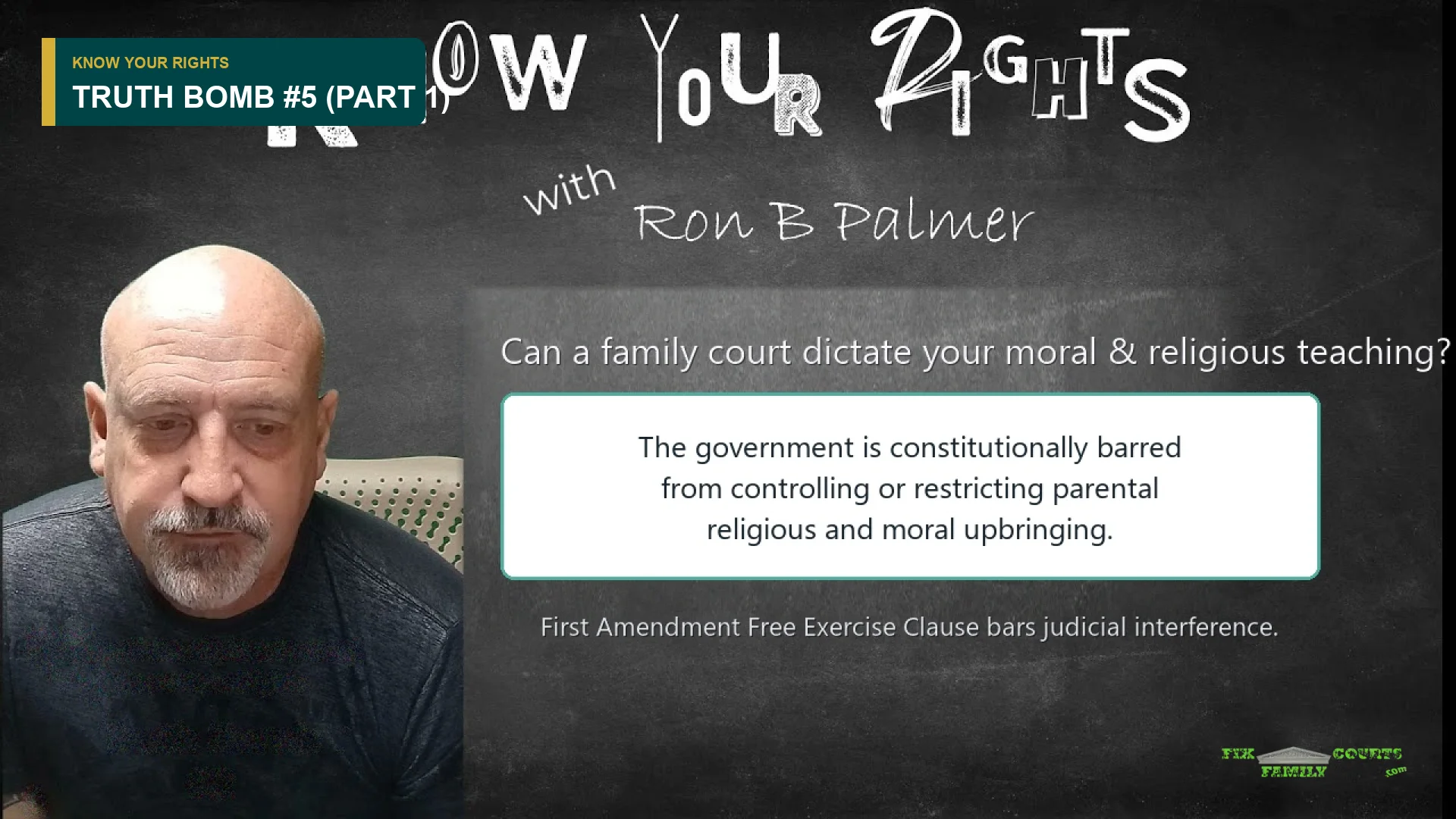
Overview: Truth Bomb 5 Part 1
What does this video cover? Truth Bomb 5 part 1
Understanding your religious rights. Religious censorship Strong constitutional argument gag orders related to religion restraining orders related to religion where do you put religious protections in your family court proceedings what are religious violations called what constitutional right is religious freedom protected under what are your child's rights how is the judge harming your child irreparable injuries what kind of associations is religion
In standard family court litigation, fit parents are routinely told that trial judges have unbounded discretion to divide custody and assign possession schedules. However, controlling Supreme Court jurisprudence strictly establishes that natural parental rights cannot be denied, stripped, or nullified without proving unfitness under strict scrutiny. Understanding these core constitutional protections empowers parents to hold attorneys and trial judges accountable to the law.
Executive Summary & Key Takeaways
- ✓ Exposes the procedural and constitutional defects in standard family court custody proceedings.
- ✓ Explains why fundamental parental rights are protected under the Fourteenth Amendment Due Process Clause.
- ✓ Equips parents with actionable legal arguments to counter judicial overreach and preserve the record for appeal.
Key Topics & Video Timestamps
Navigate directly to specific topics, arguments, and strategic insights covered in this presentation (1 indexed chapters):
Full Presentation: Truth Bomb 5 Part 1
Complete presentation (08:26) covering core parental rights and strategic legal arguments.
Constitutional Principles & Controlling Precedents
This presentation directly implicates fundamental constitutional guarantees and controlling appellate precedents:
Cited Judicial Precedents
Constitutional Protections Invoked
Full Video Transcript
While freedom of speech, thought, and belief are protected in their own right under the First Amendment, religious freedom holds a special place in our constitutional scheme. Government must stay out of religious matters. Oh really, well apparently not in family court. I know parents that are told they can't even share their religion with their children, and the judge chooses one of the religions of the parents when the two parents have differing religions. They cannot dictate to any individual how they may believe or worship. Families have a particular right to share religious thoughts, beliefs, and practices with one another. The state cannot decide what religion may be taught by a parent, whether directly or indirectly. And that part's
important. You need to know that it's not just a judge in a courtroom saying I don't like your religious beliefs so I'm going to give the child to the other parent. The simple fact that you get less time than the other parent necessarily dictates a religious violation. You see when a judge picks and winner and loser parent with differing religious views -- even slightly differing religious views -- the state makes religious choices by default. The state is then deciding which of the two parents have a greater voice in their child's religious future. This is religious censorship. It's pure and simple. This is a strong constitutional argument against the current family law system. And one that the state's seek to avoid. They're trying to
ignore this and make this go away. And if you're quiet about it, they are able to ignore it and let it go away. You must be loud and even obnoxious about your religious rights. So put these questions in their faces, by putting them in your pleadings, in your motions, and raising objections every chance you get in every hearing; any time they even mention less than equal time with your child, or less than equal rights with your child. -- raise First Amendment objections. Raise all of them individually. Raise the religious objection specifically. Put it in their faces. Don't let them get away with hiding and ignoring what they're doing. Make them face the reality that
they're violating your First Amendment rights. And they're violating your child's First Amendment rights. Because your child has the same First Amendment rights that you have to be free from the government violating those rights. Not from their parent telling what they can and can't do, but from a judge violating their First Amendment rights, the child is protected. When we're talking about the First Amendment and the freedom of association, we are talking about the two specific kinds of associations: You have intimate associations and you have expressive associations. Intimate associations are those close friends, close family, your parents, your child, close family associations that are unique and special and limited to a very small number of people.
And at the core of which is an intimacy that you don't have with other people. Now every intimate association is also an expressive association. So don't let any attorney or any judge tell you that your intimate association is protected in less or differently than your expressive association. Because you cannot have an intimate association without expressing that intimacy, and without the other person receiving that intimacy. They are absolutely expressive associations, expressive relationships; but they also happen to be a special kind of expressive association; which is an intimate association. So, the idea of this intimate association is that you share ideas and beliefs and life experiences with these people to a greater degree than you do with
other people. And they are more meaningful to you than what you may share with other people. And whether or not a child continues in their parents' religious beliefs into their adult lives has a lot to do with how much they witnessed their parent expressing their views; whether they're expressing religious views in speaking about religion, or just in living their daily lives and going about their daily lives, and the child seeing how they interact with other people; and how they express their religious viewpoints through the way they deal with other people. So this is the reason why when a judge alters your time with your child and gives you less time with your child than they give to the
other parent. That is why it violates your First Amendment right and your religious rights and your child's religious rights. Because it deprives you of the ability to convey to your child through the intimacies of daily living all of those values that you not only believe but that you practice. And it deprives the child of receiving that education. That can only come from you and no one else in the world. You are absolutely unique in this regard in that you are the only person in the world for whom this child can get this unique education and knowledge. And because you are a natural and biological parent that knowledge comes through in ways that are far deeper and
more meaningful than it would be otherwise. So the sharing of religious ideas and beliefs is a core element of the First Amendment protected right to develop intimacy in close family associations. The Supreme Court has spoken about this and has said very specifically that the intimacy, the bonds that you share with family members come from the details of daily living, from the mundane activities of living together as a family as parent and child and going through all the mundane, routine exercises of daily living. All of these things build a bond and the strength of that intimate association. And any time a judge deprives you and your child of that they are weakening those bonds. It's not good enough for you to have
your rights and your time on a weekend, and not overnights, or only on holidays. You need that daily time. You need to wake your child up and get them ready for school. You need to pick them up in the afternoon after school. You need to do homework with them. All of those things that parents do with children. You need to experience in your child and your child needs to experience from you as an individual. Not just from one of the parents but from both of you, particularly if you're divorced or not living together, or not married and not living together. Because then you have different beliefs and different values. That's why you're living together.
That's why you're divorced or never married. So it's important for your child to get both sides -- your values, their values -- both of you. So the reason we're telling you to make such a big point of this religious freedom and they're violation of your religious freedom is because it is a very powerful and compelling argument in support of the idea that you're intimate association requires that you live together as a family through the intimacies of daily life. And it requires that you do so equally with the other parent because otherwise the judge is censoring you. It's enhancing the speech of the other parent and diminishing your speech. That is censorship pure and simple. There's no way around that and the
First Amendment prohibits censorship particularly on religious views and religious ideas. So, you need to make these arguments. I mean I don't know how to stress this enough. Don't just go to the judge and say I need equal time because it's the right thing to do. You go to the judge and you say judge you're violating the First Amendment. We have a right to religious freedom. My child has a right to religious freedom. And you cannot be acting in my child's best interest if you violate my child's First Amendment rights. It's as simple as that. It is not in my child's best interest for you judge to violate their First Amendment rights. In fact, the United States Supreme Court has said that when you do so you injure the child.
If you're injuring my child you're not acting in my child's best interest judge, it's that simple.