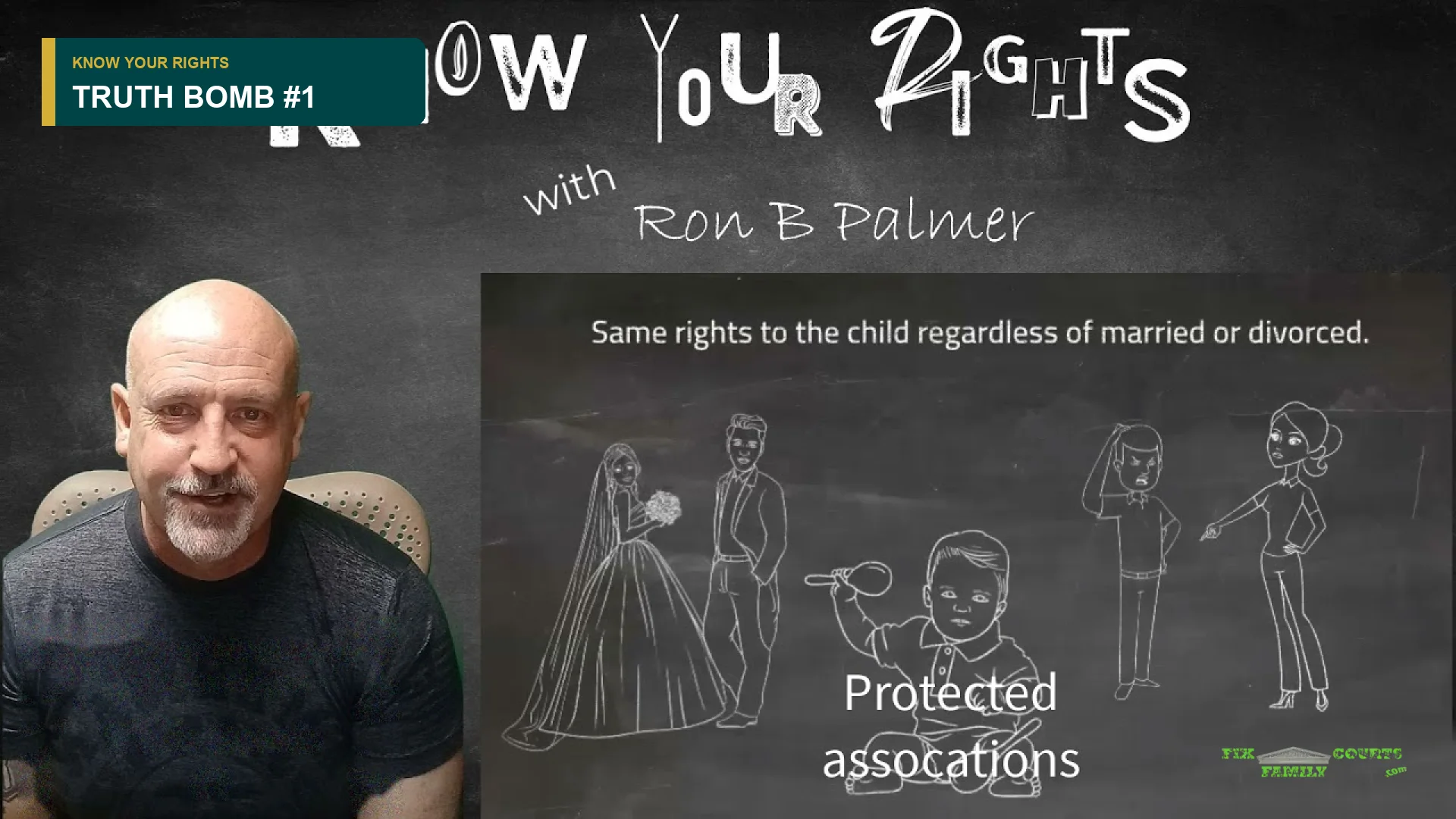
Overview: Truth Bomb 1
Learn the following in this video: Truth Bomb 1 This video contains the first of nine Truth Bombs.
1. Your relationship with your child is the source of constitutional protections for your parental rights. 2. What a penumbral right is and why you care in child custody litigation. 3. How your parental rights work in family court and how the 1st Amendment helps you protect your parent-child relationship. 4. How your association with your child actually protects you from the invasive and burdensome practices of the family court. 5. What effects your marital association or lack thereof has on the family court process, and the history of marital association. 6. What role the bastardy laws play in family court today. 7. Look at the process from a different way and free yourself from the biases that make you grovel and beg for rights to your child.
In standard family court litigation, fit parents are routinely told that trial judges have unbounded discretion to divide custody and assign possession schedules. However, controlling Supreme Court jurisprudence strictly establishes that natural parental rights cannot be denied, stripped, or nullified without proving unfitness under strict scrutiny. Understanding these core constitutional protections empowers parents to hold attorneys and trial judges accountable to the law.
Executive Summary & Key Takeaways
- ✓ Your relationship with your child is the source of constitutional protections for your parental rights.
- ✓ What a penumbral right is and why you care in child custody litigation.
- ✓ How your parental rights work in family court and how the 1st Amendment helps you protect your parent-child relationship.
- ✓ How your association with your child actually protects you from the invasive and burdensome practices of the family court.
Key Topics & Video Timestamps
Navigate directly to specific topics, arguments, and strategic insights covered in this presentation (1 indexed chapters):
Full Presentation: Truth Bomb 1
Complete presentation (23:09) covering core parental rights and strategic legal arguments.
Constitutional Principles & Controlling Precedents
This presentation directly implicates fundamental constitutional guarantees and controlling appellate precedents:
Cited Judicial Precedents
Constitutional Protections Invoked
Companion Article First Amendment Truth Bomb: Parental Rights in Family Court Read Written Guide ↓ Hide Written Guide ↑ ▼
First Amendment Truth Bomb: Parental Rights in Family Court
Introduction
Navigating family court, especially in child custody cases, can be daunting. It's crucial to understand your rights and how to protect them. This article provides a "First Amendment truth bomb" to help you keep your judge under control and ensure your constitutional rights are respected.
Understanding Your Constitutional Rights
The Constitution applies to your judge and limits their power. You and your children have rights that must be respected, even in a child custody suit between fit parents. The most important and highly protected rights are your First Amendment rights.
The Nine Truth Bombs
This article will provide a series of nine different "truth bombs" to help you present to your judge the requirement that they must do more than just express their personal viewpoint about what is best for your child. Your judge must pass First Amendment scrutiny before violating your rights.
The Source of Constitutional Protection
Your relationship with your child is the source of constitutional protections for your parental rights. It is not the marriage between you and the child's other parent that provides this source. If you are a natural parent and the child is biologically yours, you have parental rights based on the association you establish with your child.
Challenging Outdated Beliefs
Many people are stuck in a 19th-century viewpoint that parental rights depend on marriage to the child's other parent. This outdated belief, invalidated by the Supreme Court, still persists in family law. To stop this, assert your rights strongly and powerfully, forcing the courts to justify their actions.
Individual Rights vs. Marriage-Based Rights
Your rights are not based on marriage; they are individual rights. Your child's rights to you are also individual rights, not related to a nuclear family or a fantasy idea of the perfect family. One parent, one child—that's a protected association by the Constitution.
Intimate and Expressive Association
This association is protected as both an intimate and an expressive association by the First Amendment. Many attorneys argue that intimate association rights are only protected by the 14th Amendment, not the First Amendment. However, this is incorrect.
The Test of Intimate Association
Whenever an attorney or state court judge throws this argument at you, ask them: "How is it possible to have an intimate association without expressing that intimacy to the other partner, and that partner receiving that expression of intimacy?" Without that, there's no intimate association. Therefore, an intimate association, while unique, is undeniably an expressive association. They cannot be separated.
Expressive Associations
There are expressive associations that are not intimate, such as belonging to a political party. All members of the party are not intimate with one another; they don't share private aspects of their lives, which are hallmarks of an intimate association.
Protecting Your Rights
Always keep in mind that your intimate and expressive association with your child is an individual right that you and your child both have. It is protected as an individual right and as a First Amendment right. As a fit natural parent, you have every right to establish and maintain this association.
Minor Children and Parental Rights
Your minor child cannot protect their rights on their own, but you, as their fit parent, have every right to say, "My child is going to have an association with me, and because I am a fit parent, I have a constitutionally protected right to make this choice."
Supreme Court's Stance on Family Relationships
The Supreme Court has expressed this idea almost exactly like this, stating, "We have emphasized that the First Amendment protects family relationships." This is as simple as it gets. Your state court judge and opposing attorney are not arguing with you; they are arguing with the United States Supreme Court.
Association as a Penumbral Right
The First Amendment doesn't explicitly mention association. It's a penumbral right, emanating from the First Amendment. It's protected because the First Amendment protects speech, but not in a vacuum. It protects your right to speak with other people and their right to receive what you have to say. This only happens if you can associate with those people.
The Right to Association
The right to association is essential and necessary to protect the right of speech. That's where the right of association comes from, and why it's a First Amendment right. It's also protected by the 14th Amendment as a liberty interest.
Liberty Interest and the Fourteenth Amendment
The definition of liberty in the 14th Amendment incorporates the definitions of all the protected elements of the First Amendment. The Supreme Court applies First Amendment protections to the states by incorporating First Amendment definitions into the word "liberty" under the 14th Amendment.
Critical Implications for Child Custody Cases
This is critical in child custody cases because you have the right to speak to your child and educate them, and your child has the right to receive that speech from you. You have the right to share intimacy with your child, explain that you love them, and care deeply about them. These are private matters of personal choice, like religion and your place in the world, protected as matters of conscience.
Interference with First Amendment Rights
When your custody court interferes with that, they are interfering with your most basic First Amendment rights and your child's most basic fundamental rights. There are strong rules that come along with First Amendment violations, well-litigated with tons of cases. The Supreme Court has said you and your children have these rights, protected against the government.
State Court Judges and Super-Parenting
Your state court judge cannot become a super-parent and dictate what you can and cannot say to your child. That is a clear violation of the First Amendment that will not survive any challenge. The courts would hold it so if they properly applied First Amendment law.
Inherent Rights and the Constitution
Your rights to your child were inherently a special type of property right when the Constitution was created and even when the 14th Amendment was ratified. Our founding fathers thought about protecting parental rights, as several of them were parents. Thomas Jefferson, a single parent, certainly thought the Constitution protected those rights under property law.
Evolving Views on Children as Property
We can no longer tolerate the idea of children as property, even if it was a special kind of non-chattel property. They were treated as property in that the adult parent had pretty much total control over them. Rules of property were a good way to deal with this because they were clear and well-understood.
Shifting Authority and Supreme Court Rulings
In attempting to give women more authority over their children, they switched away from property rights. The Supreme Court holds that when you come forward and create an association with your child, taking over the responsibility of being a parent, the Constitution protects your rights.
Presumptions and Asserting Parental Rights
With women, this is presumed because they carry the child in their bodies for nine months and give birth. Fathers, on the other hand, have to somehow assert their parental rights over their child. One way is if you're married to the mother, the law generally presumes you are the natural parent. But the moment you come forward and take care of your child, building that parent-child association, your rights receive constitutional protection under the First Amendment.
Historical Context: Bastardy Codes
In the early days, before the early 1970s, the rights of parents came from the marital relationship between the child's parents. If they weren't married, the father had no rights to the child. These fathers weren't even required to pay child support in many places. The law was that parents of illegitimate children were not required to even care for them.
Punishing Children for Parents' Sins
In the early 1970s, a series of cases came to the Supreme Court on different subjects related to the legitimacy of children. The courts ultimately said that the law cannot punish a child for the sins of the parents. If the parents do something the government does not like, it is cruel and unjust to punish the child for what the parents did.
Individual Rights and Family Codes
The courts held very clearly that the rights are individual rights, not dependent on marriage or a nuclear family. One parent, one child creates a family unit protected by the Constitution. This transformed the landscape everywhere in law, but it didn't catch on in family law between fit parents.
Outdated Beliefs in Family Codes
Every family code is based on outdated, discredited, overturned 19th-century beliefs that your rights as a parent depend on your marriage to the child's other parent. In Texas, for instance, the judge is allowed to grant these natural parents rights after they divorce. This presumes that the rights disappear simply because you got divorced, following the old 19th-century bastardy codes.
Unconstitutional Practices
Those are unconstitutional. The famous case that said fathers had to care for their illegitimate children and child support was a Texas case that went to the United States Supreme Court. The United States Supreme Court said, "Knock it off, Texas. If a legitimate child is entitled to care, then an illegitimate child is entitled to care." The rights are individual.
The Importance of Knowing Your Rights
It's important to know and realize that everything these family codes are doing and everything these child custody judges are doing has no foundation. It's based on 19th-century beliefs that are discredited, overturned, and unconstitutional. Everything they're doing is wrong, and they know it.
Taking Action and Using Your First Amendment Rights
They only get away with it because you let them get away with it. As long as you continue to let them get away with it, they will continue to do what they've always done. Use your First Amendment rights to put a stop to this. Let them know that you know your rights are individual and cannot be taken away from you simply because you either did not marry or because you divorced the child's other parents.
Exercising Your Constitutional Rights
When they do, what that is is punishing you and punishing the child for your exercising a constitutionally protected right of choice regarding marriage. Your right to get married is a constitutionally protected choice. Your right to not get married is a constitutionally protected choice. Your right to dissolve the marital association is a constitutionally protected choice, as association rights protected by the First Amendment.
The Right to Associate and Not Associate
Your right to associate also includes your right not to associate, either by never associating or by terminating an association. Your state can't punish you for that, and they certainly can't punish your child for that. Yet, that's what they're doing.
The Real Enemy: The Judge
Knowing that your rights are individual and protected by the First Amendment is vital. This knowledge changes the game completely. Your ex is really not the enemy. It feels like your ex is the enemy, and you've got a lot of emotion tied to the ex, and the ex is certainly trying to take your rights away from you. But the ex has no state power; they have no government power.
Government Power and Child Custody Judges
They can try to take your rights away from you, but on their own, they cannot accomplish this. They have to reach out and exercise government power to take these rights away from you. The individual that does that is your child custody judge. Your child custody judge is violating the Constitution every single day of his or her life, and they know it.
Taking a Stand
It's your job to put them on the spot and let them know that you know it too, and you're not going to tolerate it. There's a lot involved in that, and we help you with every stage of that, but this is the core part of it. Knowing that the real enemy in these cases, child custody suits, is not your ex; it's the judge. The sooner you realize that, the sooner things will turn around in your case.
Fighting the Corrupt System
If you're going and begging your enemy to give you something they don't want to give you, they may laugh in your face, or they may act like they're going to give it to you and torture you with the hope that they're going to give it to you. In the end, they're going to do whatever the heck they want because they have the absolute power to do that unless you know how to stop them.
The Power of the First Amendment
The power that stops them is the First Amendment. Take this truth bomb, put it before your judge. Take the other eight truth bombs, put them before your judge. Get the motions that we provide, get the education and knowledge we provide on our membership site so that you know how to put this before the judge in a way that they cannot deny and that they cannot fight.
Conclusion
You have two choices: fight the corrupt system, knowing why the system is corrupt and how it's corrupt, or go along with the system and hope for the best. We like fighters, we're fighters, we've fought and won, and we're here to help other fighters fight and win for their children. Good luck, and I'll see you at the next truth bomb.
Full Video Transcript
Hi. I'm Ron Palmer with Fix Family Courts, and I'm here to give you a 1st Amendment Truth Bomb that you can use to keep your judge under control basically. The constitution applies to your judge, the constitution limits your judge, and you have rights and your children have rights. And those rights have to be respected even in a child custody suit between fit parents. And, the most important right you have, or the highest protected rights you have are the 1st Amendment rights. And, I'm going to give you a series of 9 different Truth Bombs that will help you put in front of your judge the requirement that your judge has to do more than just express his personal
viewpoint about what is best for your child. Your judge has to actually pass 1st Amendment scrutiny before he can violate your rights, but you need to know what these rights are and you need to understand how they apply. And here they are in simple terms, right. You're relationship with your child is the source of constitutional protections for your parental rights. Let's say that again. It is not the marriage between you and the child's other parent that provides the source of your parental rights. If you are a natural parent, and the child is biologically yours, then you have parental rights based on the association you established with your child. A lot of people don't understand this. They are still stuck in this 19th century viewpoint
that your parental rights are somehow dependent on your marriage to the child's other parent. And if that marriage goes away your parental rights go away. And the judges in the family law courts and the family law code in every state in this country are based on this outdated 19th century beliefs that have been invalidated by the Supreme Court. And yet they continue in family law. The way to stop them is to assert your rights strongly and powerfully, and force these courts to justify what they are doing. Your rights are not rights based on marriage. Your rights are individual rights. Your child's rights to you are individual rights. Not rights related to a nuclear family or some fantasy idea of the perfect family.
They are individual. One parent, one child. That's a protected association by the Constitution. And that association is protected as both an intimate and an expressive association by the 1st Amendment. Many attorneys will try to argue with you that your intimate association rights are only protected by the 14th Amendment and not by the 1st Amendment. They will say that intimacy is protected under the definition of what is a liberty interest under the 14th Amendment, not under the 1st Amendment speech protections. But they are totally wrong. They argued this with me years ago and I dug and dug and dug until I proved that they were wrong. And the Supreme Court of the United States says that they are wrong.
Now the test to this is very simple, any time an attorney throws this at you or a state court judge throws this at you, you simply ask them. "You're Honor, how is it possible to have an intimate association without expressing that intimacy to the other partner, and that partner receiving that expression of intimacy? Without that there's no intimate association. Therefore, an intimate association, while still a unique type of association, is undeniably an expressive association. They cannot be separated. Now there are expressive associations that are not intimate such as your belonging to a political party for instance. This is an expressive association of all the members of the party. But all the members of that party are not intimate with one another,
they are not close, they don't share private aspects of their lives with one another, which are the hallmarks of an intimate association. So, always, always, always, keep that in mind. You're intimate and expressive association with your child is an individual right that you and your child both have. It is protected as an individual right. It is protected as a 1st Amendment right. And you, as a fit, natural parent have every right to establish this association and maintain it. Now your minor child cannot protect their rights on their own. They cannot express their rights on their own. But you as their fit parent have every right to say, "My child is going to have an association with me. And because I am a fit parent that has a constitutionally protected
right to make this choice, my child and I share a 1st Amendment protected intimate and expressive association." The Supreme Court has expressed this idea almost exactly like this, right. And, let's talk about what they said. The Supreme Court said, "We have emphasized that the 1st Amendment protects family relationships. That's about as simple as it gets. They said a whole lot of other things in this sentence, but the pieces of this sentence that matter, that absolutely hold true is that, "We have emphasized that the 1st Amendment protects family relationships. Words of the Supreme Court not my words. So your state court judge and your opposing attorney can argue all they want but they are not arguing with me and they are not arguing with you,
they are arguing with the United States Supreme Court. Good luck with that for them. Now one of the things they'll throw at you is that the 1st Amendment says absolutely nothing about association. They're right. The word "association" is not in the 1st Amendment. So how is it a 1st Amendment protected right? It's what's called a penumbral right. Or it's one of the rights that emanate from the 1st Amendment. And it's there and it's protected precisely because the 1st Amendment protects speech. It doesn't protect speech in a vacuum. It doesn't protect your right to speak in an empty room. It protects your right to speak with other people. And it protects those other people's rights to receive what you have to say.
And that only happens if you can associate with those other people. And, therefore, the right to association is undeniably essential and necessary to protect the right of speech. And so that's where the right of association comes from and that's why it's a 1st Amendment right. It's also protected by the 14th Amendment. And you will see this quite a bit as a liberty interest, right. But that liberty interest, the definition of liberty in the 14th Amendment incorporates the definitions of all of the protected elements of the 1st Amendment. That's how the Supreme Court applies 1st Amendment protections to the states by incorporating 1st Amendment definitions into the word liberty under the 14th Amendment. So even when the 14th Amendment protects your right of
association against state action it's protecting the definitions that are inherent in the 1st Amendment, and those elements of individual liberty that the 1st Amendment protects. So, in essence, when the court talks about 14th Amendment protections for association, it's not talking about a different kind of association or a different definition of association, it's talking about those associational definitions that are inherent in the 1st Amendment and the penumbral right of 1st Amendment speech and association. This is critical for you in a child custody case because you have the right to speak to your child, and as we'll see later, the right to educate your child. And your child has the right to receive that speech from you. But from a purely intimate
standpoint, a close family standpoint, you have the right to share intimacy with your child, explain to your child that you love your child, and that you care deeply about them and how they feel and what they believe and how they're getting along in life. All those things that matter to us from a concept of "matters of conscience." Not matters that the state can interfere with, but private matters of personal choice in things like religion and your place in the world, your place in the universe. These are things that come from the heart and come from the most personal aspects of one's being. And they are protected as "matters of conscience." And your intimate association with your child requires that expression, and it requires your
child to be able to receive that. So when your custody court interferes with that, they are interfering with one of your most basic 1st Amendment rights. And your child's most basic fundamental rights. And this is critical because there are rules that come along with 1st Amendment violations. And those rules are very strong. There are a lot of them. They are well litigated. There are tons and tons of cases. The Supreme Court has said you have these rights. The Supreme Court has said children has these rights -- minor children have these rights. And they are protected against the government. They are not protected against parents from telling the child what they can and can't say. But they are protected from the government telling your child
what they can and can't say or telling you what you can or can't say. So your state court judge cannot become a super parent and start dictating to you what you can or cannot say to your child. That is a clear violation of the 1st Amendment that will not survive any kind of challenge under the family code or the idea of a child's best interest. It's just absurd. And the courts would hold it so if they're proper courts applying 1st Amendment law, right. So your rights to your child were inherently, when the constitution was created, and even when the 14th Amendment, was ratified, your rights to your child were a special type of property right. So when
our founding fathers established the constitution, and they thought about protecting parental rights, which surely they did because several of them were parents. Thomas Jefferson was a single parent. His wife had died. And he spent many years abroad while his children, his daughters were in the care of another family member. Do you think for a second Thomas Jefferson thought it was in the government's power to take his children away from him just because he was away as a diplomat in France, you're out of your mind. He did not. And he certainly thought the constitution protected those rights under property law. Because children were considered a certain type of property. If you go back far enough in your state's codes and how they dealt with custody rights, you'll find that
it was usually put into the state's property code. Now we can no longer tolerate the idea of children as property even if it was a special kind of non-chattel property. It's not like they were slaves. But they were treated as property in that the adult parent had pretty much total control of them. Far more control than we have today. And rules of property were a good clean way to deal with this because they were clear rules, they were well understood -- everybody understood them -- and the courts knew how to deal with them and follow the strict scrutiny set of rules. Now the problem with that of course was that the property laws were applied unequally,
right, and men owned all the property. Women weren't allowed to own property. And that threw a big monkey wrench in all of these things. And so, in attempting to give women more authority over their children they switched away from property rights. And ultimately where they got to or where the Supreme Court got to is holding that when you come forward and create and association with your child and take over the responsibility of being a parent -- you care for the child, you look out for their interest. That means the constitution protects your rights. That's how your rights get protected by the constitution. Now with women it's presumed this happens because they carry the child in their bodies
for nine months, they give birth to the child, they are there obviously when they give birth, and generally people are witnessing all this, so the bond between mother and child is presumed because of this. Now there are situations where this presumption would not hold. For instance, if the mother gave birth in isolation, nobody knew she was pregnant which happens occasionally. And perhaps she abandons the child immediately after. She might not even have known she was pregnant. It happens sometimes, women don't even know they are pregnant. They have babies just, they don't know what's going on. So these kind of situations that presumption might not hold up, right. Especially if the mother abandons the baby and the baby is found and later the mother
comes forward. Then there's some things that the mother has to do to prove it. But other than those exceptional cases mother's are usually presumed to be parents, the natural parent. Fathers on the other hand have to somehow assert their parental rights over their child. One of the ways this is done is if you're married to the mother, then the law generally presumes that you're the natural parent of the father, you're name goes on the birth certificate and it's all presumed. It's presumed you're the biological father. If this is not the case, there are ways to challenge all that. That's not what this is about. What the point is, because so many fathers deal with this,
is that the moment you come forward and take care of your child and build that parent-child association. You're rights receive constitutional protection under the First Amendment. This includes taking care of the mother while she is pregnant, right. Being there when the child's born. Not necessarily in the room, but being there and caring for them, and bringing them home. And doing all the things the new father would do with the child. Certainly feeding the child and caring for the child -- all those things. If you do that, the constitution protects your rights. And it protects them because of that association. That is the source of First Amendment. In the early days, for all of our recorded history, before the early 1970s, the rights of parents didn't
come from the First Amendment or the association. The law held that the rights of parents came from the marital relationship between the child's parents. If they were married to each other then they were the parents because of that marriage. If they weren't married to each other then the father had no rights to the child and the child had no rights to the father. These fathers weren't even required to pay child support in a lot of places like Texas. There's a Supreme Court case about this in Texas. Where they changed that ultimately after the 1970s. But the law was that the parents of these illegitimate or bastard children were not required to even care for their children.
Now most of the time the mother had rights to the child, but that's not an absolute. A lot of times the local governments took over the rights of the child, so even the mother didn't have natural rights to the child if she had a child out of wedlock. A lot of times they would take the child and give them to another couple, those kind of things. Put them in homes for children. All kind of things went on under what were called the bastardy codes. And then in the early 1970s a series of cases came to the Supreme Court on different subjects all related to the legitimacy of children. And the courts ultimately said that the law cannot punish
a child for the sins of the parents. So if the parents do something that the government does not like, it is cruel and unjust to punish the child for what the parents did. And this is the law. And in all of those cases, there are about seven or eight, nine of them. The courts held very clearly that the rights are individual rights not dependent on the marriage, not dependent on a nuclear family. Individual -- one parent/one child creates a family unit that is protected by the constitution. Now, this transformed the landscape everywhere in law where rights between parents and children mattered -- inheritance law was a big one. And several of these cases were about inheritance. And, but the one place it didn't catch on was in
family law between fit parents. So if you look at every family code in the state, or at least every one we've evaluated, and we've evaluated quite a few of them. Every single one of these cases, or the family codes is based on the outdated, discredited, overturned, 19th century beliefs that your rights as a parent depend on your marriage to the child's other parent. And this is evidenced in the statements that you will see in the family codes. One of them, for instance in Texas, the judge is allowed to grant these natural parents rights, parental rights, after they divorce. Well that begs the question, how can you grant a right to someone who already has that right as a natural right protected by the constitution?
What this is telling you is that these family codes are presuming that the rights disappear simply because you got divorced. And so that says they are following the old 19th century bastardy codes that tied the rights of parents and children to the marriage. Those are unconstitutional. There's no way around that. The famous case that said that fathers had to care for their illegitimate children -- child support -- was a Texas case. It went to the United States Supreme Court and the United States Supreme Court said "knock it off Texas, if a legitimate child is entitled to care then an illegitimate child is entitled to care." It's that simple. There's no way around it because the rights are individual. So this is important to know. If
you know and you realize everything these family codes are doing and everything these child custody judges are doing has no foundation, it's based on 19th century beliefs that are discredited, overturned, and unconstitutional. Everything they are doing is wrong and they know it. They only get away with it because you let them get away with it. And as long as you continue to let them get away with it, they will continue to do what they've always done. What we are suggesting is that you use your First Amendment rights to put a stop to this. You let them know that you know your rights are individual and they cannot be taken away from you simply because you either did not marry or because you divorced the child's other parent.
Because when they do, what that is, is punishing you and punishing the child for rights you're exercising -- a constitutionally protected right of choice regarding marriage. Your right to get married is a constitutionally protected choice. Your right to not get married is a constitutionally protected choice. And your right to dissolve the marital association is a constitutionally protected choice as association rights protected by the 1st Amendment. The right to associate also includes your right not to associate either by never associating or by terminating your association. And your state can't punish you for that, and they certainly cannot punish your child for that. That's what they are doing. So knowing that your rights are individual and are protected by the First Amendment is vital. So this knowledge,
individual First Amendment protected parental rights changes this game completely. One of the things you'll realize after you realize the individual nature of the rights and the First Amendment protected nature of the rights. Is that your ex is really not the enemy. It feels like your ex is the enemy, and you've got a lot of emotion tied to the ex, and the ex is certainly trying to take your rights away from you. But the ex has no state power. They have no government power. They can try to take your rights away from you, but on their own they cannot accomplish this. They have to reach out and exercise government power to take these rights away from you. And the individual that does that is your child custody judge.
And your child custody judge is violating the constitution every single day of his or her life and they know it; at least the intelligent ones know it. And it's your job to put them on the spot and let them know that you know it too and you're not going to tolerate it. There's a lot involved in that and we help you with every stage of that. But this is the core part of it. Knowing that the real enemy in these cases, child custody suit, is not your ex, it's the judge. The sooner you realize that, the sooner things will turn around in your case. If you're going and begging your enemy to give you something they don't want to give you
they may laugh in your face or they may act like they're going to give it to you and torture you with the hope that they're going to give it to you. In the end, they're going to do whatever the heck they want because they have the absolute power to do that unless you know how to stop them. And the power that stops them is the first amendment. So take this Truth Bomb and put it before your judge, and the other 8 Truth Bombs and put them before your judge. Get the motions that we, the sample motions that we provide, get the education and knowledge we provide in our membership site, so that you know how to put this before the judge in a way that they cannot deny,
and that they cannot fight. Or you just go along with the system, beg the judge, and you get what you get --- whatever, it's just your kids right? Your choice. You fight the corrupt system, knowing why the system's corrupt and how it's corrupt, or you go along with the system and hope for the best. That's the only two choices you've got. We like fighters. We're fighters. We fought and won. And we're to help other fighters fight and win for their children. So good luck and I'll see you at the next Truth Bomb.