Overview: Truth Bomb 2 Part 1
Important information you will learn in this video: Truth Bomb 2 part 1
Ron explains how the First Amendment protects your right to educate your child how you see fit in parent versus parent high conflict divorce child custody battles, and how the Fourteenth Amendment applies to the states, and why that's important to the protection of your parent-child association.
In standard family court litigation, fit parents are routinely told that trial judges have unbounded discretion to divide custody and assign possession schedules. However, controlling Supreme Court jurisprudence strictly establishes that natural parental rights cannot be denied, stripped, or nullified without proving unfitness under strict scrutiny. Understanding these core constitutional protections empowers parents to hold attorneys and trial judges accountable to the law.
Executive Summary & Key Takeaways
- ✓ Exposes the procedural and constitutional defects in standard family court custody proceedings.
- ✓ Explains why fundamental parental rights are protected under the Fourteenth Amendment Due Process Clause.
- ✓ Equips parents with actionable legal arguments to counter judicial overreach and preserve the record for appeal.
Key Topics & Video Timestamps
Navigate directly to specific topics, arguments, and strategic insights covered in this presentation (1 indexed chapters):
Full Presentation: Truth Bomb 2 Part 1
Complete presentation (13:57) covering core parental rights and strategic legal arguments.
Constitutional Principles & Controlling Precedents
This presentation directly implicates fundamental constitutional guarantees and controlling appellate precedents:
Cited Judicial Precedents
Constitutional Protections Invoked
Companion Article Important information you will learn in this video: Truth Bomb 2 part 1 Read Written Guide ↓ Hide Written Guide ↑ ▼
Important information you will learn in this video: Truth Bomb 2 part 1
Ron explains how the First Amendment protects your right to educate your child how you see fit in parent versus parent high conflict divorce child custody battles, and how the Fourteenth Amendment applies to the states, and why that's important to the protection of your parent-child association.
Important terms: Inculcate, Precept, Example, and Associate
If you need a deeper dive into understanding how to articulate your rights to your attorney, to your judge, to anyone who is trying to interfere with your rights, get a membership on our site and get in touch with us here: www.FixFamilyCourts.com/membership/
Want to read all the Truth Bombs:9 First Amendment Truth Bombs
Full Video Transcript
Truth Bomb number 2 is, it is your right to educate your child is protected by the First Amendment. Not someone else's right, you're right as a parent -- is tied to your parental rights. You get to protect, you get to educate your children. Not the government, not the judge, you. The Supreme Court has been very explicit in this regard, and it's held specifically that -- the right to educate one's children as one chooses is made applicable to the states by the force of the First and the Fourteenth Amendments. And education is very simple. It is simply the expression and the reception of fact and ideas. And what receives the most protection is your right to teach your child your personal
values. Those ideas that come to you as a matter of conscience. Ideas about religion, about life, about our existence in the universe -- why we exist. All of these kind of questions, deeply personal questions. It's your job to convey to your child your beliefs. Your ex has the same right and the same duty. And then your child is to incorporate all of that into who they are as they grow up and when they become an adult they get to decide for themselves what their place in the universe is, and the foundation for that comes from the parents. Not from a judge, not from the state, not from the government -- from two fit parents. If the
child has two fit parents, married or not, that child has a right to those two parents, and has a right to learn equally from those two parents. No judge has a right to get in the way of this. If you're fit, that judge has no authority to get in between. The First Amendment doesn't allow it. They come up with all kind of excuses, but you need to know, Supreme Court says your right, your individual right to educate your child is protected by the First Amendment. And you need to stand up and present that to the Court and require the Court to treat your rights with the respect they deserve. So essential to the First Amendment is both the right to speak
and the right to receive. The speaker has a right and the receiver has a right, both right are protected by the First Amendment. Speaking and receiving go hand and hand. So inherent in the intimate association between parent and child is the parent's duty to educate the child in a manner which preferably makes them productive citizens. But at least to a degree that keeps them from becoming a burden on others. Hold up, hold up, you're state statutes however are making you believe that the judge gets to override your values, morals, and teachings. And when he does that he violates your right to be who you choose to be and to share that with your child, and to develop your child in the ways that you
decide are right for your child. And the attorney just says the attorney has a right to do this because the statute says he does. And sometimes your rights are expressed in the form of duties and responsibilities. Ron's going to explain. The Supreme Court has expressed this duty in the following manner. The duty to prepare the child for additional obligations must be read to include the inculcation of moral standards, religious beliefs and elements of good citizenship. This affirmative process of teaching, guiding, and inspiring by precept and example is essential to the growth of young people to mature, socially responsible citizens. That's the Supreme Court's words, word for word. That matters. Okay? The Supreme
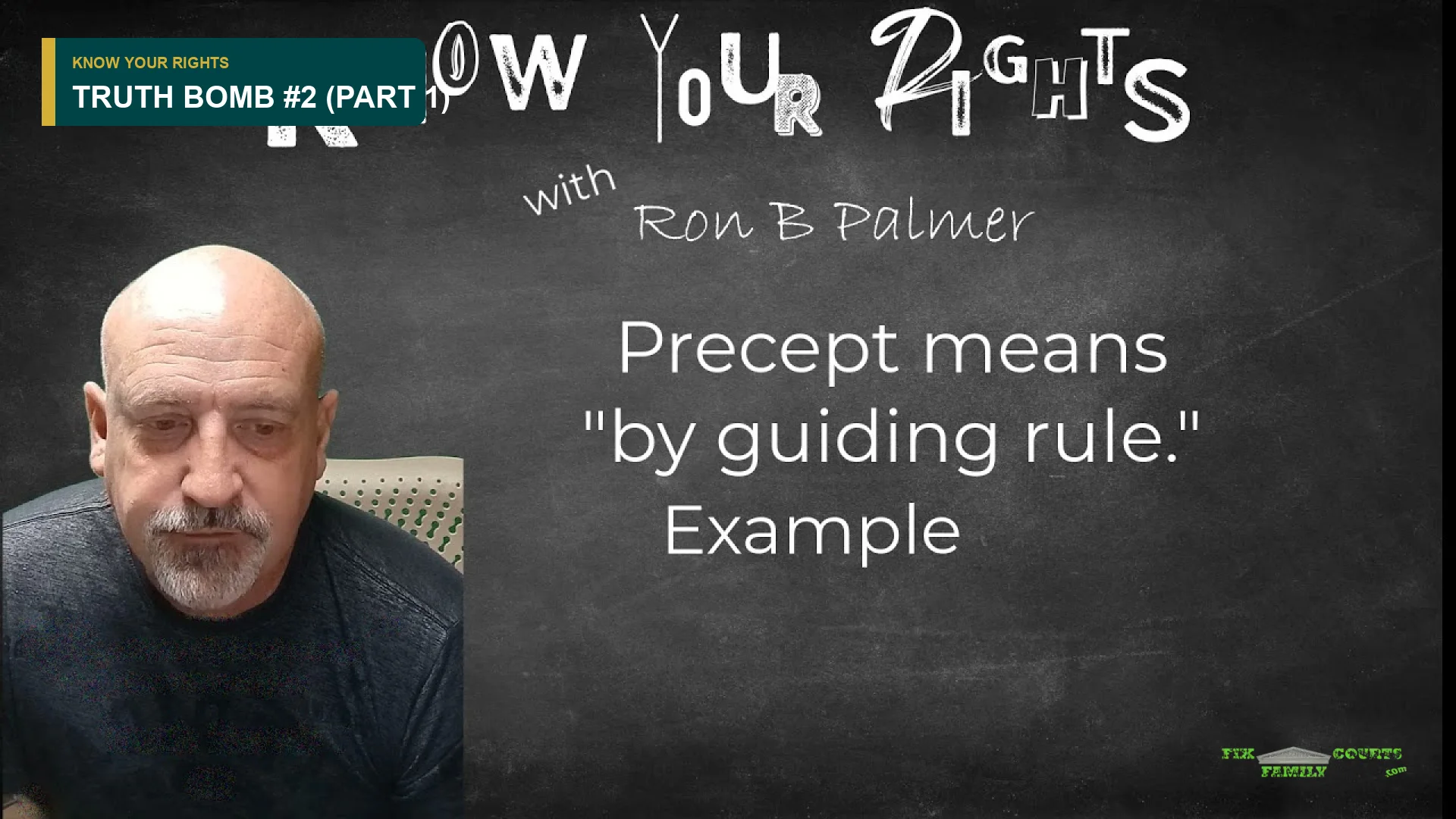
Court says it, no state judge can overrule it or say it doesn't matter. We need to put it before these judges and demand that they respect it to the level that the Supreme Court requires. Now, in that statement, the words precept and example are critical elements of the holding. The word precept simply means "by guiding rule." You're teaching your children guiding rules for life. Precepts. What's more interesting than precept in the child custody context, is the example part of the statement. So how exactly does a parent teach their child by example if the state custody judge doesn't let them have any time with their child? Or gives them only a certain kind of time. Any limitation on your time directly affects your child and what
they can receive. It limits your ability to comply with your duty to educate your child. So, unless there's a way to teach by example without associating with the person you are teaching, this reference to example by the Court means you're right to associate with your child for the purpose of educating them by example is protected by the First Amendment. Children learn by watching what we do. They are always watching. Even when you think they are not watching, they are watching, and they are learning. They are seeing what you do and how you respond in all kinds of situations. From the most mundane boring situations in life to the most important. They are always watching and they are always learning.
And they take this to heart even if they don't consciously recognize it. They take it to heart and they will remember these things for the rest of their lives. And they will apply these things they learn in their adult lives in ways they won't even recognize. Nevertheless, they are there and you are building this foundation. So in another case, the Supreme Court explained the reason the First Amendment protects intimate associations, is because it is through these bonds of affection we transmit shared ideals and beliefs from generation to generation. The Court stated it this way, "The Court has long recognized that because the Bill of Rights is designed to secure individual liberty, it must afford the formation and preservation of certain kinds of highly personal relationships
a substantial measure of sanctuary from unjustified interference by the state. We have noted that certain kinds of personal bonds have played a critical role in culture and traditions of the nation. By cultivating and transmitting shared ideals and beliefs, they thereby foster diversity and act as critical buffers between the individual and the power of the state." This is not the first time the Court had something to say about the role of intimate family associations in sharing values across generations. Some years earlier, the Court stated it this way, "Our decisions establish that the constitution protects the sanctity of the family precisely because the institution of the family is deeply rooted in this nation's history and tradition.
It is through the family that we inculcate and pass down many of our most cherished values, moral and cultural. Ours is by no means limited to the tradition of the respect on uniting the members of a nuclear family." So, here they are saying that this is core to our nations history and tradition, the respect that we give families -- parent-child associations. And the Court is also saying it is not limited to the nuclear family. The Court protects association pairs. The smallest nuclear family in existence is actually a collection of three protected family units. There is the marital association between husband and wife. That is a protected family unit whether or not they have children. When they have a child, they add
two more distinctly protected associations. On top of the marital association between the mother and the father, they now have a parent-child association between the mother and the child and a parent-child association between the father and the child. These three individually separately protected family units combined establish the nuclear family. And it is only through these individual associations that the nuclear family can receive any kind of constitutional protection. And that's because our constitution protects individual rights. Not group rights. Not large membership rights. Even when you're talking about your right to associate with a, a political party with numbers in the millions, it's not the group that receives protection, it's each individual in the group that receives the protection.
Now it may be worded in terms of group to make it easier to understand. But when you get down to nuts and tacks, it is each individual association that gets the protection. So, the smallest, when we talk about equal protection of large groups, what we're really talking about is each individual. It may be a member of a particular group, has a right to be treated the same. So the smallest group the equal protection clause protects is the individual. It always protects the individual. Some years later, the Supreme Court had some more to say about association rights of natural parents and their children. And the Court said it this way, "Choices about marriage, family
life, and the upbringing of children, are among the associational rights this Court has ranked as a basic importance in our society. Rights sheltered by the Fourteenth Amendment against the state's unwarranted usurpation disregard or disrespect a parent's desire for and right to the companionship, care, custody, and management of his or her children is an important interest. One that undeniably warrants deference. And absent a powerful, countervailing interest, protection. The interest of parents and their relationship with their children is sufficiently fundamental to come within the finite class of liberty interests protected by the Fourteenth Amendment. So, here, the reference to the Fourteenth Amendment is not a denial that the protected rights are protected by the First Amendment, but instead is a statement that the First Amendment
protected rights are protected from the action of states because it is the Fourteenth Amendment which applies constitutional limitations to the states. Before the Fourteenth Amendment, the federal constitution simply didn't limit the states. The Fourteenth Amendment was put in place to compel the states to comply with our federal constitution. So, in the 50s, 60s, and 70s, when the black civil rights movement was really changing our nation, they faced two significant problems: One was black people in general didn't really believe they had rights they could fight for; and, two, there weren't any significant number of court opinions or case law that would support the idea that black people had rights. So they had to do two things. First, people
like Martin Luther King, Jr. and churches, black churches all over the country started talking to black people and telling them they had rights, and teaching them they had rights, and getting them willing to fight for their rights. And then people like Thurgood Marshall, who was a civil rights attorney, and who later became a Supreme Court justice -- the first black Supreme Court justice we've ever had. He was fighting the legal battles, and he was winning small case after small case in the appellate courts. So, when he finally did get to the Supreme Court, on the big civil rights question for black people, he was able to win because he had that wide support of underlying small case law that all led up to that big win in the courts.
And that's what we need to do in family rights and parental rights. We need to convince more parents that they should stand up and fight for their rights in the courts. And we need to get a lot of these small wins in the appellate courts that support the fact that we have civil rights that deserve to be protected. And then we need to push it all the way to the Supreme Court, if necessary, to get that sea change and understanding in our nation that says parents have rights, they're individual rights, they don't depend on marriage, and the courts cannot deprive them of their rights simply because they get divorced or choose never to marry.