
The Nuremberg Defense in Family Court: “It Was Just My Job”
The Ethical Dilemma: In child custody litigation, evaluators, guardians ad litem, attorneys, and judges frequently dismantle fit parent-child relationships under the pretext of standard institutional procedure. Justifying the severing of natural parental bonds with the bureaucratic excuse that “it was just my job” violates fundamental constitutional principles and inflicts lifelong, scientifically documented psychological trauma on both children and parents.
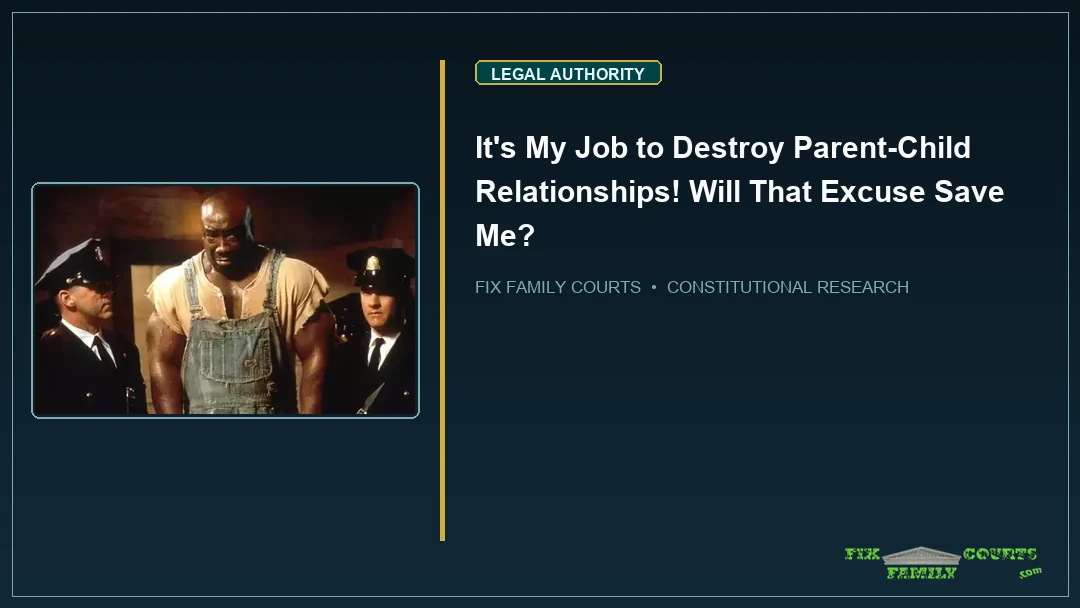
Only parents who have endured a high-conflict custody battle can truly relate to that unforgettable scene in The Green Mile, where the warden’s wife says to John Coffey—the man on death row who has just miraculously saved her life: “I dreamed of you… we were both wandering in the dark and we found each other.”
When you are trapped in the family court machine, you pray and dream for someone to come and take away the relentless pain and terror that the domestic relations system inflicts. You search desperately for that single piece of hope that seems nowhere to be found. When she handed him her necklace, it struck at the very core of what parents feel: Where was that person when I needed someone to make the family courts stop tearing my children away from me?
This is all that loving parents and children need—someone to hand them the truth and the tools that free them from the destructive incentives of the family court industry. Instead, parents beg for help and find silence. You pour your life savings, and even your children’s college funds, into litigation believing your retained attorney is protecting your rights, only to watch them compromise away your custody. You plead for mercy from a judge to hear you and protect your child, only to find yourself attacked, silenced, and subjected to intrusive investigations into your private life just to retain basic access to your own son or daughter.
You wait and hope for that one person who can rescue your family from this cycle of procedural violence. But the savior never arrives, and parents feel like they are dying inside. Most of you reading this are the ones who refused to surrender hope—as was I. That is why my husband Ron and I dedicate our lives to this work. We know there is a constitutional path forward. Every time we witness a family being shattered by this system, we want to reach out, take their hand, and guide them onto the procedural path that restores their life and frees them from state-sponsored punishment.
“On the day of my judgment, when I stand before God and He asks me why did I kill one of His true miracles, what am I going to say? That it was my job?”
— Paul Edgecomb, The Green Mile (1999)
I ask every attorney, judge, custody evaluator, guardian ad litem, and mental health professional who participates in severing a fit parent from their child: What will you say when called to account? Will you claim that tearing families apart was simply your job? That stripping children of fit parents was how you “protected” them?
Will That Bureaucratic Excuse Relieve You From Moral Accountability?
You have a choice. You can continue forcing parents and children to live with “pieces of glass” [1] in their heads, traumatized and exhausted. Or you can hear the desperate cries of parents and children pleading for understanding. They feel alone, powerless, and devastated. They are not asking to have their bonds severed—they are begging to be protected from a predatory, unguided process.
You do not protect a child by convincing them that they require state protection from their own fit, loving mother or father. You are invading the constitutionally protected private realm of the family without lawful justification. When you allow personal biases, moral preferences, or financial incentives to dictate custody recommendations, you inflict profound injury on children, parents, and the community.
Under the American constitutional system, the state has no authority to force subjective moral notions onto fit legal parents—not even during divorce.
The Parent-Child Bonding Necklace: Why Daily Routine Matters
Children thrive when they are permitted to remain in what they recognize as their normal and natural environments. [2] Parents must be allowed to collect the daily “beads of experience” through ordinary routines and string them onto the parent-child necklace [3] that forms the foundation of lifelong attachment.
Spontaneous Moments Build Attachment
Helping with homework, sharing casual thoughts at the dinner table, walking around the yard, or sitting together on the couch. These micro-interactions cannot be scheduled into an every-other-weekend schedule.
Visitor Status Unravels the Bond
When a fit parent is reduced to an alternate-weekend visitor or alienated entirely, the beads stop being collected. One by one, the beads fall away until the necklace of connection unravels.

Children learn by continuous observation, absorbing character and values that cannot be taught through words alone.
[4] Nobody instructed this little boy to copy his father’s pushups. It happens spontaneously through exposure and immersion. But this natural observational learning cannot occur when a child is stripped of meaningful, everyday contact with that parent. You cannot simulate authentic parental influence through brief phone calls or sterile supervised visits.
Life brings enough natural sorrow without courts creating artificial deaths of parent-child relationships. We invite legal and mental health professionals to stop being part of the destructive machine and instead become the helping hand that preserves equal parental bonds.
References & Explanatory Notes
- The Green Mile Reference: Alludes to John Coffey’s description of emotional suffering in the film adaptation of Stephen King’s The Green Mile (Frank Darabont, 1999), and Paul Edgecomb’s dialogue regarding moral culpability under duty. Watch Dialogue Clip ↩
- Scope of Legal Advocacy: This analysis applies within the bounds of constitutional law. Fix Family Courts does not advocate for children to remain in abusive, neglectful, or illegal environments. Rather, we advocate for fit parents going through separation or divorce to be afforded the same constitutional respect, fundamental rights, and due process protections guaranteed to married and intact families. ↩
- Dr. Amy J.L. Baker’s Attachment Analogy: Adapted from Dr. Amy J.L. Baker’s presentation on parental alienation in Chicago. Dr. Baker demonstrated that parent-child bonding is constructed like a necklace composed of daily, routine “beads” of natural interaction. When frequent and ordinary contact is severed, beads fall away and the attachment structure disintegrates. For further research, see Dr. Baker’s published works on parental alienation syndrome and attachment preservation. ↩
- Observational Learning & First Amendment Expression: Image commentary originally discussed on Facebook via Parents Everywhere. Ron B. Palmer noted: “This picture captures exactly why parental rights are intimately intertwined with our First Amendment rights and equal possession time. Parents have an equal right to teach their children. Children learn by example and they have a right to learn equally from both parents.” ↩