

Constitutional Limits on the Best Interest of the Child Standard: Under the Fourteenth Amendment Due Process Clause, a fit parent's decisions regarding child custody and upbringing are conclusively presumed to serve the child's best interests (Troxel v. Granville, 530 U.S. 57). Trial judges possess no subject-matter jurisdiction to replace a fit parent's judgment with subjective judicial discretion absent an affirmative evidentiary finding of parental unfitness proven by clear and convincing evidence (Santosky v. Kramer).
TRFRA Section 110.004: Texas Defense to Best Interest Orders
The Texas Religious Freedom Restoration Act (TRFRA) provides an affirmative statutory defense against unlawful government action. In a SAPCR between fit parents, the judge is a government official exercising state power—and that judicial power is strictly circumscribed by Chapter 110.
Why Best Interest Does NOT Overrule Parental Civil Rights
Civil rights under the 14th Amendment are individual liberties that state statutes cannot displace. Watch this clear explanation of constitutional supremacy over state domestic relations codes.
State Action Doctrine: Judges Are Bound by TRFRA
Statutory ShieldJudicial Action Is Government Action: Judges frequently claim that child custody suits are private civil matters between individuals. That is false. The judge is a state official exercising sovereign power pursuant to state codes. TRFRA Section 110.003 explicitly bars judges from issuing any order or decree that substantially burdens a parent's or child's religious freedoms.
Section 110.004 Defense: This section explicitly establishes that TRFRA may be asserted as a defense in judicial proceedings "without regard to whether the proceeding is brought in the name of the state or by any other person."
Sec. 110.004. Defense.
Added by Acts 1999, 76th Leg., ch. 399, Sec. 1, eff. Aug. 30, 1999. Sovereign immunity waived under Sec. 110.008 with remedies and attorney's fees available under Sec. 110.005.

Related Educational Guides & Authorities
Continue exploring constitutional principles, case law precedents, and procedural strategies.

Making the Best Interest Determination is Political NOT Judicial
Understand why the 'best interest of the child' standard is unconstitutional without proving parental unfitnes...
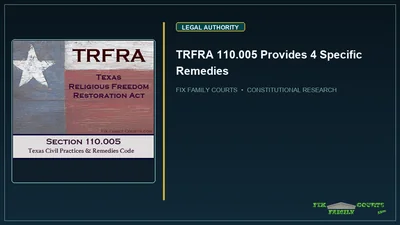
TRFRA 110.005 Provides 4 Specific Remedies
Fix Family Courts explains that parental rights are fundamental constitutional liberties protected by the Four...

Best Interest NOT a legal Conflict
Understand why the 'best interest of the child' standard is unconstitutional without proving parental unfitnes...