
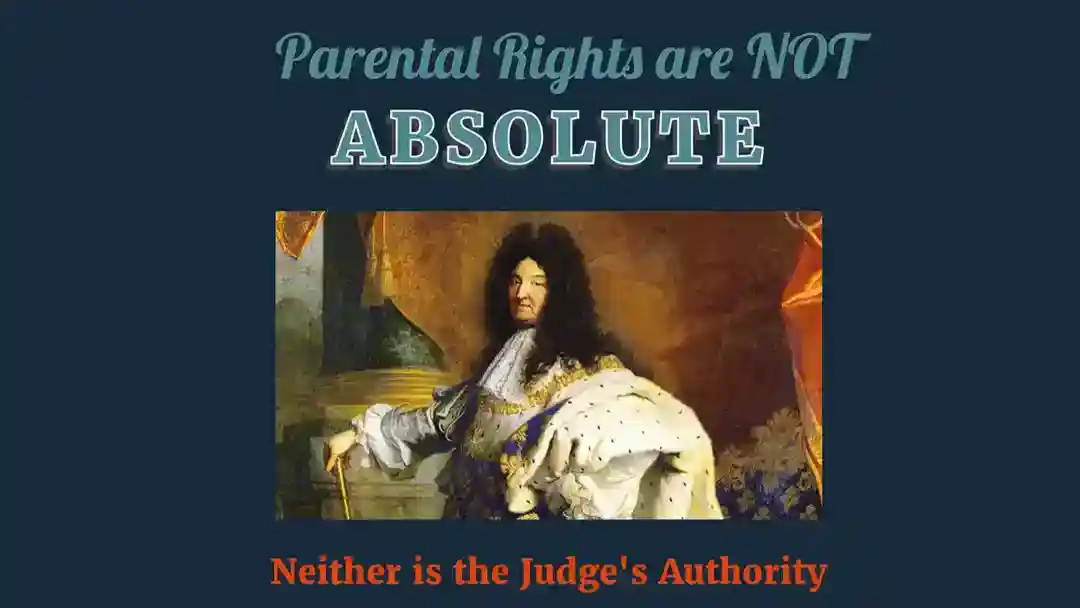
How to respond
How to respond when a child custody judge tells you that your parental rights are NOT absolute:
Of course your honor, few if any rights are absolute but by the same token NO governmental authority in this country is or can be absolute. My rights are however protected against this Court's "unwarranted usurpation, disregard, or disrespect," MLB v. SLJ, 1996, because this Court's exercise of "granted powers are always subject to the limitation that they may not be exercised in a way that violates other specific provisions of the Constitution," Williams v. Rhodes, 1968. This Court's discretionary "power, broad as it is, may not be invoked in such a way as to violate" id. my fundamental parental rights or my child's fundamental rights except where this Court demonstrates authority that can survive strict scrutiny review applicable to the protection of fundamental rights of the nature at issue here.
The nature of my personal private rights and my child's personal private rights are in part defined as follows:
My rights are individually protected private fundamental rights as are my child's rights. They belong to each of us as individuals and can NOT, under the Equal Protection Clause, be made by this court or by this state to depend upon the marital stuatus of between parents nor to changes in that marital status except under terms of strict scrutiny as applicable to discrimination infringing upon fundamental rights.
Since at least 1968 it has been held unconstitutional to deny rights to a child as consequence of a marital choice made by the cild's parent, Levy v. Louisiana and it is therefore unconstitutional for this Court to deprive my child of any rights in these proceedings. Any such denial would be "illogical and unjust," Weber v. Aetna Casualty & Surety Co., 1972. My child's legal status, relative to a marriage between parents "however defined, is, like race or national origin, a characteristic determined by causes not within the control of [my child], and it bears no relation to [my child]'s ability to participate in and contribute to society." Id.
In 1965, the Supreme Court held that it has "long been established that a State may not impose a penalty upon those who exercise a right guaranteed by the Constitution," Harman v. Forssenius. In 1996, the Supreme Court held that "Choices about marriage, family life, and the upbringing of children" are rights of association "ranked as of basic importance in our society" that are "sheltered by the Fourteenth Amendment against the State's unwarranted usurpation, disregard, or disrespect." MLB v. SLJ.
In 1965, the Supreme Court held that my right to educate my child and my child's right to be educated by me is protected by the First and Fourteenth Amendments as expression of opinion that can NOT be infringed under this Court's broad authority, Griswold v. Connecticut. Expression of opinion through association are protected against stat action by the First Amendment as incorporated into the Fourteenth Amendment in Gitlow v. New York, 1929. "Association in that context is a form of expression of opinion." griswold, supra, where expression is protected as held in NAACP v. Alabama, 1958.
Should this Court deny my child these First Amendment rights or should this Court fail to provide my child with all applicable constitutional guarantees protecting the entirety of their First Amendment rights, this Court will be irreparably injuring my child, Elrod v. Burns, 1976. Under NO circumstances is it possible for this court to assert any legitimate interest in irreparably injuring my child, period. Penalties imposed on the child by the state as condition of parental divorce is strictly forbidden.
This Court can NOT possibly act in my child's best interests by irreparably injuring my child.
Furthermore, when the judge of this Court enters these proceedings predisposed to irreparably injure my child rather than to adjudicate my child's rights against the state's unconstitutional assertions of state power, this Court denies my child their right to fundamentally fair judicial process to protect those rights under both the state and federal constitutions.
This Court acts legitimately only where it fully and equally protects the rights of each litigant parent, respecting their privacy choices and imposing structure only as "necessary" to achieve a specirically identified compelling justification and only where the least restrictive means legitimately available to the court is applied. If there is any doubt, full and equal, 50/50 shared custody between fit parents is the least restrictive legitimate means available to this court and deviations from this bar must be demonstrated necessary to achieve the asserted compelling justification.
Ron B Palmer, Feburary 8, 2026.
Discussion of Issues
When you hear a judge tell you that your parental rights are NOT absolute the odds are very high that your judge is telling you that he or she is a criminal who has criminal mens rea to unlawfully violate your civil rights.
There is NO doubt whatsoever that a judge’s intentional violation of your civil rights is a crime and this is the crime, 18 U.S.C. § 242 Deprivation of Rights Under Color of Law. See what the Justice Department has to say about this statute below.
What your judge is implying when they make this statement is that your rights are limited but their power is unlimited and this is anabsolute lie designed to cover up criminal behavior.
The Fourteenth Amendment exists to limit the power of all state government which includes executive power, legislative power, and judicial power. It requires that state child custody judges provide federal due process and Equal Protection standards to protect your rights and your child’s rights from any exercise of state legislative or judicial power.
When your judge enters your case predetermined to litigate the best interests of your nonparty nonlitigant child against your rights and predetermined to issue relief in your child’s best interests against your rights then your judge is entering the proceedings with criminal intent (mens rea) to violate your civil rights. This criminal distinction becomes especially important when we seek to demonstrate how "income-based" child support is felony forced labor under federal law, where abuse of law is an element of the crime.
Procedural due process mandates that judges provide fundamentally fair judicial process. The burden of meeting this duty falls to the judge and to the judge alone. This is why it is irrellivant whether the state or a private party initiates the suit. Either way, the judge bears the burden of providing fundamentally fair judicial process. The only difference when the state initates suit is that the executive official bringing suit will have additional "substantive" due process burdens to meet, that private parties are NOT held to.
What is fair about predetermined outcomes, outcomes that always serve the state's viewpoint regarding the arbitrary choice of "best"? What is fair about depriving you of rights under civil law policy mandates without permitting you to challenge that civil law mandate? What is fair about your judge acting as the state’s agent who is predetermined to impose the state’s civil law policy against your rights rather than protecting you from unlawful application of the civil law? The judge can NOT simultaneously be neutral, impartial, and independent from the state's interests while asserting state policy authority to impose that policy against you by presumption.
Procedural due process mandates that the state’s regulation of your fundamental rights is presumptively unconstitutional until the state appears and overcomes this constitutional presumption by entering testimony subject to your confrontation and cross-examination of that testimony. When your judge waives this burden of proof, your judge acts criminally. When your judge acts as the state, your judge acts criminally. When your judge issues final orders violating your rights without first adjudicating their legitimate authority to issue those orders, your judge acts criminally.
Substantive due process mandates that you are entitled to access to a state court where you can vindicate your federal rights before a neutral and impartial judicial decision-maker who is NOT predetermined to rule against your interests.
In child custody cases, the judge is on the state’s side against your interests and is acting as the state’s direct civil law agent imposing the state’s civil law as a state regulator against your interests and in the process the judge deprives you of your fundamental right of access to a neutral and impartial judicial decision-maker in your case.
Where the Supreme Court has held that your parental rights are fundamental rights, substantive due process mandates that the state demonstrates a compelling state interest and narrowly tailored state authority before it can limit your rights. Even then, the means the state uses must be the least restrictive means or option available to the state. Until this standard is met through adjudication, your child custody judge has zero judicial jurisdiction to limit your rights. Any resulting orders are advisory orders that are nullities under law. The reality is that every child custody and child support order in this country is likely an absoult nullity. The consequences of this simple fact are staggering to comprehend.
Judges know that they act criminally when they knowingly act without jurisdiction and they know that their resulting orders are advisory orders that are absolute nullities under law.
Your judge should know full well that all the way back in 1984, the Supreme Court heard a child custody modification appeal and held that the state’s goal of acting in the child’s best interest was merely a “substantial” state interest which is less than “compelling” and therefore insufficient to justify infringements of fundamental rights protected by the compelling state interest test.
This means that the judge’s opinion of your child’s best interest has zero power to legitimately deprive you of your fundamental rights such as close family speech and association that are protected by the compelling justification standard against child custody order prior restraints on speech and association.
Your judge knows that only narrowly tailored state authority can be applied to limit your fundamental rights. Yet, your judge claims “broad discretion” to determine your child’s best interest to violate your rights justified only by that merely "substantial" best interest goal. “Broad discretion” to determine "best" is literally the polar opposite of narrow tailoring.
Your judge has a duty to know the law and a duty to honestly apply the law. This duty is spelled out in your state’s Code of Judicial Conduct. Violations of this code are sanctionable and when you file complaints against your judge, this is the standard that your complaints should call out.
In most states, child custody judges are authorized to impose NO Contact orders against parents based entirely upon the judge's best interest viewpoint regarding matters of conscience in child-rearing and the judge's broad authority. As you can imagine, a NO Contact order is the polar opposite of least restrictive means and unquestionably a viewpoint-based prior restraint on parent-child speech and association. Never in the history of the Supreme Court has it ever found a viewpoint-based prior restraint to be justifiable.
All of this is imposed against you because the state classified you and your child as being undeserving of the same constitutional guarantees of all other parents and children. In Texas for instance, fit parents are reclassified as "conservators" and rather than protecting the existing rights of fit parents as conservators, Texas presumes that the rights of conservators are defined by the state and that your rights to make childcare determinations are absolutely nullified and conveyed to the court alone. This nullification of your rights happens the instant the child custody suit is filed and even though they hide the fact, Texas compels the filing of the child custody suit in divorce cases, Texas Family Code 6.406.
Your parental rights are “individual” rights established individually by each parent through different methods and protected by the federal constitution as private rights of the individual with zero dependence upon a marriage between the child’s parents. Yet your state’s family code presumes that only the rights of married parents and their children are constitutionally protected and the rights of unmarried parents or divorced parents and their children are de facto terminated by the absence of a marriage between the child’s parents.
This is the classic Bastardy Code relabeled to hide from the constitutional prohibition against Bastardy Codes. In Kansas for instance, they simply disallowed the use of the term "illegitimate child" as used in bastardy case precedent while continuing to impose the exact same disabilities on the child as they did under the illegitimate child label. Your child is treated asa bastard child regardless of the state’s uses of other labels or protestations that your child is not an illegitimate child. What the state actually does rather than what the state simply claims is the true constitutional test.
It is unconstitutional for your state court judge to compare your rights as a divorced parent against the rights of married parents and claim that you are not similarly situated to married parents and thus your rights may be infringed while theirs cannot. Your state court judge has a duty to know this simple inescapable rule of law.
It is straight up marital discrimination to claim that married parents have rights but unmarried parents or divorced parents do not. The criminality of the child custody courts is so blatant and so obvious that it is extremely difficult to believe that these judges could be so brazenly criminal, but they are undeniably acting intentionally criminally.
If your judge is NOT being intentionally criminal, then the alternative is that your judge is so incompetent in the basic law of this country that he or she is unqualified to serve as a judge under the standards they publish. These are the only two available options, judges are either openly criminal or stupidly incompetent.
More How You Should Respond
The following is another example of how I might respond to any child custody judge who tried to tell me that my parental rights are not absolute:
Your Honor, I am fully aware that my fundamental rights are NOT absolute but then neither is your authority to violate my rights absolute. The Fourteenth Amendment directly limits your authority to violate my rights and the constitutional standard under both due process and Equal Protection that this court must meet is strict scrutiny.
The state’s interest in my child’s best interests, your viewpoint of my child’s best interests, and your claim of broad authority all violate strict scrutiny. The fact that my child has NOT and could NOT establish standing to have their best interests litigated or to receive judicial relief in their best interests deprives this Court of subject matter jurisdiction (this argument applies in half of states to varing degrees but applies fully in Texas as standing to sue is a state law issue but it carries federal due process implications) and this court proceeds in the complete absence of jurisdiction when it vindicates the state’s best interest public policy against agenda my fundamental rights without an adequate adjudicative process.
Vindicating the state’s best interest public policy in direct conflict with the rights of individuals is an administrative and regulatory action NOT a judicial action and it is impossible for this Court to simultaneously pursue the state’s policy interests against me and meet its constitutional mandate to provide fundamentally fair judicial process.
I demand litigation of my constitutional rights as against the state’s civil law regulation of my rights and I object to any claim by this Court that protecting my rights is contrary to my child’s best interests as a tyrannical absurdity that doesn’t pass the smell test.
Parents NOT judges determine their child’s best interests, and the First Amendment absolutely protects my right to disagree with the child’s other parent and with this Court regarding matters of conscience in child rearing such as what is "best" and absolutely deprives this Court of any jurisdiction over matters of conscience in child-rearing based on its viewpoint regarding what is "best."
Ron B Palmer
18 U.S.C. § 242 Deprivation of Rights Under Color of Law
What the Justice Department says about this statute:
This provision makes it a crime for someone acting under color of law to willfully deprive a person of a right or privilege protected by the Constitution or laws of the United States. It is not necessary that the offense be motivated by racial bias or by any other animus.
Defendants act under color of law when they wield power vested by a government entity. Those prosecuted under the statute typically include police officers, sheriff’s deputies, and prison guards. However other government actors, such as judges, district attorneys, other public officials, and public school employees can also act under color of law and can be prosecuted under this statute.
Section 242 does not criminalize any particular type of abusive conduct. Instead, it incorporates by reference rights defined by the Constitution, federal statutes, and interpretive case law. Cases charged by federal prosecutors most often involve physical or sexual assaults. The Department has also prosecuted public officials for thefts, false arrests, evidence-planting, and failing to protect someone in custody from constitutional violations committed by others.
A violation of the statute is a misdemeanor, unless prosecutors prove one of the statutory aggravating factors such as a bodily injury, use of a dangerous weapon, kidnapping, aggravated sexual abuse, death resulting, or attempt to kill, in which case there are graduated penalties up to and including life in prison or death. If charged in conjunction with 18 U.S.C. § 250, as noted below, all sexual assaults under color of law are felonies.
Conclusion
The American judiciary is by far the most corrupt of the three branches of government. State court judges are operating a nation-wide criminal enterprise where the states conspire to irreparably injure money and to criminally force parents to labor for the state's financial benefit. I believe that this organized criminal enterprise operated by state court judges meets all of the conditions necessary for them and most of those who financially benefit from this criminal enterprise to be charged with federal forced labor felonies.
I am actively engaged in documenting specific proof of this allegation so that parents can sue for the mandatory damages awards permissible under forced labor civil relief statutes that are written to defeat every argument I have seen for the absurdly corrupt absolute judicial immunity which permits this criminal enterprise to survive as it has. These statutes appear to permit mandatory damages relief against attorneys, GALs, judges, and anyone else who financially benefits with reckless disregard for the fact that they benefit from this criminal activity.
Ron B Palmer, Feburary 8, 2026.
Child custody judges injure children for money because they think parents are too stupid to call them out as criminals. While you can file a formal request with the "US Attorney" for your state, NOT to be confused with your state Attorney General, to have your judge investigated for this crime, don’t expect them to be prosecuted. However, informing the judge in writing through a formal written objection to his or her violations and filing formal charges with the US Attorney will begin to expose these judges and put pressure on them to clean up their act.
If enough parents start to do this, US Attorneys might also feel pressure to actually enforce the law against these criminals. This has real teeth because judges don't have any judicial immunity against criminal actions.
This will get a great deal stronger when we finalize the explanation of how "income-based" child support issued by state judges thorugh their criminal abuses of law and process are federal forced labor felonies and the nation-wide scheme is classified as organized crime. I believe that the US Attorney General will take a much more direct and aggressive interest in these issues when framed in the felony forced labor context that is inherent in "income-based" child support imposed by state judges who first nullified all federal rights of the parent forced to labor under the judge's best interest claims of authority.
File your criminal and civil rights complaints with the US Attorney at the US Attonry Website