The Best Interest Controversy
The best interest controversy is what makes the entire child custody system a fraud and you can prove it.
By: Ron B Palmer | Posted: | Modified:
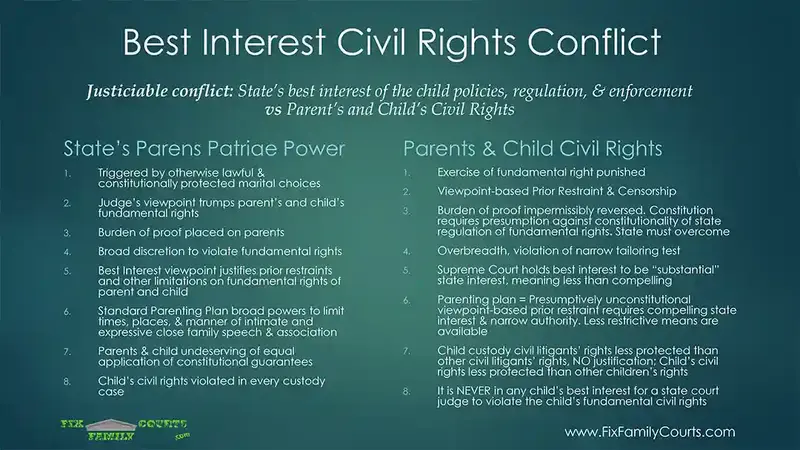
Courts deal with controversies, and it is vital to identify the controversy at issue.
The Best Interest Controversy
Child custody courts will claim that your custody suit is a civil suit between private parties and while that is true, it isn'tthe whole story.
Under the common law and equity used historically before civil family codes were established, the argument that child custody suits areonly civil suits between private parties may have been justifiable depending on the actions the court chose to take. However, under civil law, this idea fails.

When a state legislature establishes a civil policy, such as the best interests of the child policy, the State creates a legalconflict between the state and the individuals whose rights become limited under that policy. So, the best interest of the child civil law policy establishes additional conflicts beyond just the private party conflict between the litigant parents. These conflicts involve federal civil rights and can only be resolved using federal law NOT state law.
While the law is constitutionally barred from recognizing justiciable conflicts between fit parents and their children except thrugh the Santosky Standard, the state's Best Interests of the Child policy does create a conflict between the state and the child. The moment that either parent files a child custody petition, the rights of both fit parents and the rights of the children to each of those fit parents are simply nullified without regard for the fact that the Supremacy Clause, the one that judges swore to be bound by, asserts that there exists NO state authority of any kind to nullify fedreal rights.
... although States retain substantial leeway to establish the contours of their judicial systems, they lack authority to nullify a federal right or cause of action they believe is inconsistent with their local policies. — US Supreme Court 2009
The filing of a child custody petition is an enumerated First Amendment right the exercise of which the state may NOT punish. Judges have NO authority to infringe upon constitutional rights except that authority that is first proven in an adjudicative process. Best interest skips the adjudicative process altogether and goes straigt to the sentencing faze where you are presumed to be guilty. This is one of the primary mechanisms by which you can prove that best interest is facially unconstitutional. It is facially invalid because there exists NO means under the law for you to access a competent court to adjudicate your rights against infringent under the state's best interest of the child policy.
It has long been established that a State may not impose a penalty upon those who exercise a right guaranteed by the Constitution. — US Supreme Court 1965
Parental rights are individual federally protected rights that attach to each parent individually and they consist of intimate andexpressive close family speech and association rights as well as numerous privacy rights interests. The Child has personal individually protected rights of their own such as the right to have and to maintain intimate and expressive close family speech and association with each fit parent. The Child also has concomitant rights which mirrorthe rights of the fit parents. Where the parent makes a protected care, custody, or control choice for the child, the child is protectedby that choice and is entitled to the protection of that privacy choice by concomitant right. The protection is NOT from the otherparent but protection from the state and from any judge who has predetermined to apply the state's best interests policies againstyour rights and against your child's rights. What the Supreme Court has declared very succinctly is that the state does NOT have "free-floating power to restrict the ideas to which children may be exposed." However this is precisely the goal that the judge sets out to achieve under best interest.
The State's best interests of the child civil law policy generally holds that the state can do pretty much whatever it wants with your child against your wishes upon no more justification than the written viewpoint of a sole government official stating. Simply by declaring it to be in the child's best interest, the judge acquires free-floating state authority to suppress the ideas of the disfavored parent and to enhance the ideas of the "favored" parent for no other reason that his or her personal viewpoint regarding which parental ideas are best. They accomplish this censorship through custody orders that limit the times, places, and manner in which the speech can happen and by compelling the disfavored parent to subsidize the favored parent's speech through arbitrarily imposed "income-based" child support orders.
Minors are entitled to a significant measure of First Amendment protection... No doubt a State possesses legitimate power to protect children from harm… but that does not include a free-floating power to restrict the ideas to which children may be exposed. — US Supreme Court 2011
Because the State's policy asserts state authority to violate federally protected civil rights,at every point where the asserted authority puts a protected right at risk, the State creates a legal point of controversy that isjusticiable, meaning it is a controversy that state courts can resolve by exercise of their inherent federal jurisdiction andapplication of federal law to the federal questions. This action creates a justiciable conflict between each fit parent and the state aswell as between each child and the state that can only be resolved by federal law.
This word "justiciable" is important and has a general usage as well as some very specific usages. When addressing questionsof standing and subject matter jurisdiction the distinctions must become very precise and apply to each element of relief pleaded. Herewe are using the more generalized form of the word meaning that a controversy exists that is subject to resolution through the judicialprocess because some form of relief is available through judicial action if properly pleaded. We have a separate line of legal reasoningdemonstrating why child custody courts lack subject matter jurisdiction under best interests because of standing issues.
The child custody court will ignore the justiciable conflicts that the state's best interests of the child policy creates between itself and the fit parents and between itself and each child, if you allow the court to get away with this fraud. If you do, you are essentially saying that you waive your rights relative to the conflict created by the assertion of state authority against your fundamental rights and you accept the State's authority to deprive you of rights by the terms of the statute. If your attorney goes along with this illusion, you will have effectively waived your rights and permitted the state to do as it pleases with your child against your objections. Your attorney will have violated their fiduciary duty to inform you of your rights.
Two Reasons Why
There are two reasons why your judge will attempt at all costs to ignore these justiciable conflicts. The first is that your judge has already agreed, before your suit was even filed, to act as the state’s agent in pursuing the state’s policy interests against the interests of every litigant in every child custody case between fit parents. This means that the justiciable conflict between you and the state is also a justiciable conflict between you and your judge which disqualifies your judge under the requirement that the courtremain neutral, impartial, and independent. The judge cannot be a judge in a case where he has standing to be a litigant. If your judge asserts broad discretion to violate your fundamental rights in pursuit of his or her viewpoint of your child's best interests,your judge has standing because they are claiming authority to exercise executive power against you. The proof of this is in your state's Code of Judicial Conduct. Most address these neutrality issues in multipleplaces.
The neutrality requirement helps to guarantee that life, liberty, or property will not be taken on the basis of an erroneous or distorted conception of the facts or the law. At the same time, it preserves both the appearance and reality of fairness, generating the feeling, so important to a popular government, that justice has been done, by ensuring that no person will be deprived of his interests in the absence of a proceeding in which he may present his case with assurance that the arbiter is not predisposed to find against him. — US Supreme Court 1980
Ask your child custody judge which comes first, your constitutional rights and your child's constitutional rights or the judges viewpoint of your child's best interests and the judge's desire to exercise free-ranging powre to protect your child from harms the judge imagines he sees. He will tell you and likely articulate controlling state precedent that best interest comes first. What he won't do is properly lable his best interest based orders as unlawful viewpoint based discrimination.
This is one of the core reasons why it is absolutely and unquestionably unconstitutional for judges to regulate state domestic relationspolicy interests. If your judge claims he or she does NOT regulate domestic relations policy related to child custody suits between fit parents, then ask your judge who the state’s accountable executive agency or executive official is because you want to sue them for civil rights violations. If the judge cannot identify an official, then the state cannot demonstrate its jurisdiction to deprive you of any fundamental rights under its civil law at all. This is a catch-22 for the state. If the legislature has failed to delegate, to anexecutive official, authority to appear in court and assert the state's interests under the policy, then best interest is the only justification that can be asserted and it must fail because the Supreme Court says it is NOT compelling.
The Court held that even the best interests of a child did not constitute a compelling state interest. — US Supreme Court 2003, concurring opinion by Justices Thomas and Scalia
Another reason your child custody court ignores these conflicts created by the state's civil code is that your judge benefits inmultiple ways, including financially, from failing to recognize and adjudicate those conflicts. If your judge were to recognize theseconflicts, your judge would be forced to recuse. Every state judge would be forced to recuse unless one of them were to hold theState's civil law scheme to be unconstitutional. Then the judge could resolve the issues through equity so long as he or she fullycomplied with all controlling federal law.
The reason for this is very straight forward and most people already have a fair grasp of how this works. Under common law and equity, courts have dealt with conflicts between individuals without the state taking an active part. While some issues such as property rights may have been defined under the civil law, the state did NOT take a position of adversity against either or both parties. The State merely established the contours of the privacy right. The Court then did what courts are supposed to do, they protected the rights under constituionally permissible rules. Your judge may claim this to be the same in child custody courts, but the facts just don’t support that assertion. Under equity, judges don't claim authority to violate fundamental rights through means that cannot survive constitutional review. The state and federal constitutions absolutely limit your judge's equitable powers.
According to well-established principles of equity, a plaintiff seeking a permanent injunction must satisfy a four-factor test before a court may grant such relief. A plaintiff must demonstrate: (1) that it has suffered an irreparable injury; (2) that remedies available at law, such as monetary damages, are inadequate to compensate for that injury; (3) that, considering the balance of hardships between the plaintiff and defendant, a remedy in equity is warranted; and (4) that the public interest would not be disserved by a permanent injunction… The decision to grant or deny permanent injunctive relief is an act of equitable discretion by the district court, reviewable on appeal for abuse of discretion. — US Supreme Court 2006, (unanamous)
How is child custody similar to property law?
Property law is a classic and appropriate example of how judges typically apply civil law, because children and women were onceconsidered by the law to be a specific type of property and their rights were often managed by the courts through property law. Child custody statutes, if they existed, were typically found in the property codes. This means that our founding fathers expected their parental rights to be protected through the Fourth and later thorugh the Fourteenth Amendments because that was the legal expectation when thoseamendments were written, (history and tradition). The Supreme Court has since held that parental rights are protected by the First Amendment as speech andassociation rights.
When two private individuals have a property dispute, one or both files suit against the other and a court applies the neutral propertylaws to determine which rights each party has to the property in question. At NO point does the State ever seize the property, or claimto have custody of the property, nor does the State presume power to "grant" property rights to the party found to have those rights. In this way, property disputes under the civil law are addressed very differently from child custody disputes under thecivil law. Of overriding importance is the fact that if a nonproperty holder is violating the rights of the property holder, there exists concrete injury that is necessary for equitable relief.
This Court has long instructed that equitable relief must be limited to the inadequacy that produced the injury in fact. Any remedy a judge authorizes must not be more burdensome to the defendant than necessary to redress the complaining parties. In equity it all connects—the broader and deeper the remedy the plaintiff wants, the stronger the plaintiff ’s story needs to be. — US Supreme Court 2023
When one parent files a custody suit against the other parent, the states perform a magical sleight of hand that is unquestionably fraudulent. Unlike in a property dispute, the moment a parent files a child custody suit against the other parent, the state,interestingly enough, recognizes that each parent has full and equal constitutionally protected custody rights over the child. These rights are a protection of the individual against state action to infringe the rights. That both parents hold the same full and equal parental rights distinguishes child custody from most property cases where there is only one property owner and the other litigant is a trespasser. Rather than adjudicate the rights of the parents fairly in compliance with constitutional law, the court uses the existence of the full and equal rights as a means of illegally seizing custody of the child for the State and nullifying all parent and child rights. Just filing a child custody suit deprives you of your fundamental rights requiring the stateto prove absolutely noting before seizing custody of your child from you.
Minor children are always in someone's custody. If there is NOT a fit parent or a legal guardian to hold this custody then the state's parent of "last" resort doctrine, parens patriae, is invoked and the state becomes the child's guardian by operation of law and public policy. You were served because the state recognized your existing parental rights or at least your interest in the proceedings. The moment the state asserts best interest as the conrolling factor in the case, and the judge agrees to replace your rights to defend your rights against the state's asserted policy and to become the administrator of those policy interests, your rights and your child's rights are nullifed. It takes both the legislature and the judiciary conspiring to violate rights for this to work. They also need to buy off the executive which is how Title IV-D money is typically spent.
I didn't realize that this was the thinking until we helped in a Maryland appeal where an appellate court made exactly thisholding by saying that each parent has full and equal rights and therefore the rights cancel out and the state can do whatever it pleases. It sounded all legal and logical the way that judge articulated it, but this absurd statement quickly falls apart under closer examination.
A constitutional right protects the individual from state action in an individualized fashion. If one person has a fundamental right, that person is protected against state action taken to infringe that right. If another person has that same right, that person is alsoprotected against state action to infringe that right. Now imagine if two people have full and equal right to a piece of land as aproperty right. Do their individual property rights as protected by the Fourth Amendment still protect each of them from government infringement of the right? The answer is yes, absolutely. Can the state presume away the property rights simply because two people holdthose rights? NO!
The slight of hand here, is that the court treated the parental rights as if the rights were protection against the actions of the other private party—the Kansas Supreme Court also asserts that procedural due process protects only against the other litigant and uses this to impose arbitrary marital discrimination. However, this can NOT be because the Fourteenth Amendment does NOT protect anyone against private actions, it only protects against "state" actions. The rights of the parents cannot cancel out because they do NOT and can NOT clash in that way. The civil and criminal law applied by the amendment's terms, NOT the Fourteenth Amendment itself, are the appropriate mechanisms to protect private individuals from other private individuals violating their rights. Sadly, there is nobody tricker at manipulating the perception of law to support their own personalself-interests than judges.
In a situation such as this, the state cannot claim the property for itself and then "grant" the property back to whicheverof the two property owners a court feels will do what is best for the land. The state is required to apply a constitutional balancingtest conducted under strict federal due process rules to determine first if both claims of right are valid, and if both are valid, applythose rules to balance the rights through application of the least restrictive means available to the court. The court may limit how theland may be used if a use by one landowner would violate the rights of the other. The court may divide the land between the two. thecourt may order the property sold. The court will certainly hold that when the property is sold, each owner will get a percentage of theprofits in proportion to their ownership percentage, with the split being 50/50 if each has full ownership.
Children are significantly different from property as they cannot be sold or subdivided. However, the rights of each parent can and mustbe balanced through exactly the same type of federally approved balancing tests, the Mathews Test in this case. Where each parent hasfull and equal parental rights claims to the child, the court cannot take custody from either parent and "grant" the custodyrights to one of them.
Just like with the property, the State has NO legitimate authority to seize the child from either fit parent and thus NO source ofauthority to "grant" custody of the child back to the parent the judge likes. This is the magical sleight of hand thatnobody sees and that nobody is challenging properly.
To grant a thing, the grantor must be in possession of the thing. This applies to child custody rights and all other forms of parentalrights. These rights of natural parents come from biological parentage and gain federal constitutional protection the moment a naturalparent establishes a parental relationship with the child and takes on parental duties for the child.
At NO point in this process does the State ever have rights over the child nor is the State ever in possession of these natural rightssuch that the State has any claim of authority to "grant" these rights to a natural parent. This is true even when paternityis contested and proven in court. No state claim of parens patriae authority can overcome this because parens patriae authority isauthority of last resort applying only when no fit parent is available or when the state is credibly challenging a parent’s fitness in acompetent fitness court.
NO! The child custody court is NOT a competent fitness court and cannot make legitimate findings of fitness or unfitness.
Theconstitution requires that child custody courts presume both parents to be fit and to be making choices that are best for their child.There is NO divorce exception to this rule. Nor can the judge of your custody court act as the state's prosecutor to accuse youand prosecute you for unfitness. To start with the judge would have to commit the charges to writing and personally serve you with thecharges for them before he could legitimately claim jurisdiction over a fitness finding.
The state can never grant natural rights
One of the many fundamental legal errors in family law is the idea that the State ever has, or can ever have, authority to"grant" rights to a natural parent. "Granting" natural rights is simply a legal impossibility. The State canrecognize natural rights. The State can protect natural rights. The State can infringe natural rights, but the State can never"grant" natural rights. For instance, in adoptions, the state does NOT "grant" natural rights. The technicalpath is that the state grants parental rights to the adoptive parents where there are no willing fit parents, and then statutes definethat those adoptive parental rights will be protected to the same degree as natural parental rights but they never actually becomenatural rights. Regardless of how strongly they are protected, the rights are always a state grant of right.
Because so many parents want to battle over parental rights, states are able to maintain their fraud as an open secret. If you ask yourcourt for full custody over your child against another fit parent, you are perpetuating, seeking to benefit from, and protecting thefraud. You should only be asking that your full and equal parental rights be protected to strict scrutiny standards. This standard willresult in 50/50 rights and custody because that is the least restrictive option available to the court.
Your Ex has NO Right of Action against Your Rights
The right to file an action for relief requires standing. The Fourteenth Amendment exists to protect your constitutional rights against state action. The state tries very hard to frame child custody as a civil suit between private parties but that isn't enough. When the legislature or the executive denies rights the Fourteenth Amendment is invoked. It is absolutely the same when a judge denies rights. Fourteenth Amendment protections apply. Your existing rights must be recognized and protected. Child custody courts set up a false conflict under the false assumption that the judge is somehow entitled to exercise state power to violate your rights if a private party to a suit asks them to. Under that absurd theory, an private party could ask a judge to put the other litigant to death, and the Fourteenth Amendment would be powerless to stop it. The simple fact is that neither your ex, nor even your child, have any legitimate authority to compel a judge to violate your rights. Only the government can initiate a suit directly against your rights. Cops use this lie all the time when they claim they got a complaint so you aren't protected against their unconstituioal searches and seizures. I am in federal court right now because cops broke into my home and violently assaulted me justified only by the fact that someone complained about noncriminal issues where NO harm was done to anyone. You need to be on guard for this common lie that divorce courts tell.
The Constitution confers upon no individual the right to demand action by the State which results in the denial of equal protection of the laws to other individuals. — US Supreme Court 1948
What is the proper course of action in a child custody suit?
The proper course of action is to establish as a fact before the court that you are the natural biological parent, that you haveestablished a parent-child relationship, and that you have taken on parental duties for the child. Consequently, your natural parentalrights are vested with federal constitutional protections for you as an individual against any state action, including judicial action,against your federally protected natural rights. The State has NO source of lawful authority to "grant" these rights to youbecause these rights are yours individually, are fully vested in you as an individual, and are federally protected.
What should I be asking the court in a child custody suit?
Because you are a full and equal natural parent, you should be asking the court to protect your rights fully and equally to your childand protect your child's rights to you under a balancing of rights whereby the full and equal rights of each parent are fullyprotected and the child's full and equal rights to each parent are protected. It is the reality of your desire to exercise yourrights separately from the other parent and the other parent's desire to do the same that creates the necessity of balancing wheneach parent may exercise their rights independent from the other parent, but in a manner that does NOT subject the other parent tosubstantial loss of rights. The actions of the parents, not the state, causes the division of time and access. The state merely appliesthe civil or equitable law appropriately under the Fourteenth Amendment to protect each parent's rights from being infringed bythe other parent.
Here, an example of substantial loss would be one parent authorizing a risky elective surgery where the child may die, resulting in aloss of parental rights for the parent NOT making the choice. Courts can legitimately and constitutionally impose limits on theunilateral choices of fit parents if doing so protects the rights of the other parent and is the least restrictive option.
Rather than the Court claiming authority to "grant" rights to one or both parents, the Court would be protecting rights byestablishing an equitable scheme under which each parent has opportunity to equally exercise their rights. This is the purpose and roleof the courts, and this is fully consistent with the state court's federal duties. There is no doubt that your state court coulddo this right now today. That court may need to first declare the state's family code to be unconstitutional, to remove civil lawpreemption of his or her equitable and common law authority, but state family codes are all so blatantly unconstitutional in so manyways that this is easily done. Pick a parental right, any right, and I will show you how your family code blatantly violates it.
The Proper Burden of Proof
The path to declaring the family code unconstitutional is for the court to first recognize the legal conflict created by the family codeand recognize the fundamental nature of the close family rights at issue. Because the family code seeks to regulate core fundamentalrights, recognizing the conflict also causes the court to assert the proper burden of proof beginning with the mandatory presumptionthat the family code is unconstitutional where it seeks to regulate fundamental rights.
In this case the burden of proof holds that the State must appear before the court, prove its jurisdiction to assert its interestsregarding the child in this civil dispute, then demonstrate through evidence placed into the record through testimony subjected toconfrontation and cross-examination that the State's family code contains sufficient constitutional guarantees to overcome thepresumption against its constitutionality. One of the reasons your judge cannot legally act as the state’s best interest agent is thatthe judge cannot testify in his or her own court and thus cannot possibly demonstrate that the burden of proof has been met. The rulesunder equity are a bit different, but under equity, the court has a means of ensuring that the required proof is demonstrated in therecord. The level of constitutional protection provided through checks and balances is less under equitable law than under the civil lawbut the standards of constitutional review are the same.
The outcome of this path under current civil law best interest policies is undeniably that the State cannot demonstrate sufficient proofthat its interests in pursuing its own viewpoint of your child's best interests provides the state with any authority whatsoeverto violate core fundamental rights. The reason is simple. Legitimate limitation of core fundamental rights, through application of thecivil law, requires the state to demonstrate a compelling state interest and narrowly tailored authority to infringe fundamental rightsin pursuit of that compelling state interest. The State cannot possibly prove this because best interest isn't compelling, and thejudge cannot testify.
The United States Supreme Court has ruled, in a child custody modification appeal between divorced parents, that the State'sinterest in pursuing its opinion of the child's best interests is at best merely "substantial" and thereforeinsufficient to overcome the compelling state interests test. Consequently, best interests can NEVER be applied as justification toovercome regulation of a core fundamental right or to impose prior limitations on parent-child speech or association, all of whichrequire a compelling state justification of narrowly tailored state authority, applied using least restrictive means.
An even easier proof is the fact that your child custody court claims "broad authority" to violate your fundamental rights.The Supreme Court has held, too many times to easily count, that fundamental rights may NOT be violated by application of"broad" authority. Fundamental rights are always protected by some degree of enhanced scrutiny. There is NOT a singleestablished enhanced scrutiny test that permits the use of broad authority to violate any fundamental right.
Best interest of the child is an openly accepted fraud
This last one is why best interest is such an openly accepted fraud. There is NO justification for any bar certified attorney to everbelieve that a fundamental right may be violated through application of "broad" authority. Every last one of them has aprofessional duty to know better. Yet in family law, they all quietly go along with the court's claim of "broaddiscretion" to violate the fundamental rights of parents and their children because it is in their personal, professional, andfinancial best interests to do so. That is until a parent comes along who is willing to sue their attorney for violation of theirfiduciary duty to protect the parent's fundamental rights against such a blatant violation. The system will self-correct rapidlywhen attorneys realize they can be sued for damages for not making the simple claim that the child custody judge cannot violatefundamental rights through use of broad discretion.
The only way the legislature, the courts, and the attorneys can maintain this fraudulent fiction is if they all openly agree to refuseto acknowledge the clear and unmistakable legal conflicts created by the state's best interests of the child policies, and by itsfamily code, against the constitutional interests of both parents and child. If they simply refuse to recognize the conflict, and youdon’t insist that the controversy be recognized, then they don't have to answer the hard constitutional and professional questionsand they don't have to give up the money.
Imagine having spent twenty or thirty years failing to perform your fiduciary duty as an attorney, to protect the rights of yourclients, and some parent tells you that best interest creates a legal conflict for them with their clients. If the attorney accepts theconflict and applies the law, he or she quickly realizes that they may finally have to face the music for committing fiduciary fraud forall those years. Then, of course, they would need to find a new way to earn a living, because where the constitution is followed infamily law, only a tiny few attorneys will ever be required.
Now imagine you are a judge having spent ten or more years on the bench depriving fit parents and children of their fundamental rights.Recognizing the conflict forces you to face the fact that what you have done for so long is truly evil and illegal. Recognizing theconflict would change public perception from seeing judges as the great protectors of children to seeing judges as the perpetrators of agreat institutional evil on the level of historical racial and gender discrimination.
Make no mistake, competent judges already understand the evil they have been committing for so long, and they know that openly facingthat evil means facing public disgrace. Not only that, but child custody suits are a significant proportion of the suits that courtshear. If most future child custody suits result in 50/50 custody without a fight and altering that outcome would require a parent toovercome strict scrutiny protections for the other parent's and the child's rights to each other, most states would quicklyfind that they have far more judges than they actually need. Then many judges and many courts would be chopped in the cost cutting spreethat would follow.
Best Interest undeniably creates a legal conflict between the state and your parental rights. You need to demand that your attorney andthe judge recognize this conflict and adjudicate this conflict properly in full compliance with federal law. This won't be easy todo because your attorney and your judge have a financial interest in preventing you from receiving an adjudication of this conflict. Butif you argue for it in the right way, and don’t give in, they will have a very hard time denying you.
Your secret weapon is a tool called advisory opinions. Judges are prohibited from issuing advisory opinions and any final opinion thatfails to resolve the conflict is an advisory opinion that cannot bind the parties to the suit. This means that every existing parentingplan is illegal and unenforceable.
The secret to unraveling the entire family law system
Forcing your attorney and the court to recognize and adjudicate this controversy is the string, that when pulled, will cause theentire corrupt system to unravel.
One of the first things you will realize is that your court isn't competent to adjudicate this conflict because your court hasalready accepted the legislature's best interests of the child command to assert the state's viewpoint of the child'sinterests against your constitutional interests. Your judge has already picked sides against you, against the other parent, and againstyour child. The state will win in your case, without even having to appear as a party, because your judge is the state's agentwillingly doing the state's bidding against your interests. This result is foreordained by your judge's open conspiracy withyour state's legislature. This makes your court both biased and dependent on the state's policy interests in violation ofyour fundamental due process and equal protection rights.
Commit this idea to your long-term memory and use it in you case. The equal protection challenge is NOT that your rights are treateddifferently from the rights of married parents. The challenge is that the rules being used to justify depriving you of your fundamentalrights in this civil suit are substantially different from the rules applying to all other civil litigants in all other types of civilactions. If the child-custody civil court classifies you as less deserving of the same constitutional protections as other civillitigants generally receive, then your court must justify that classification by the rules of equal protection under strict scrutiny.
The entire scam is held up by lies stacked on top of lies by judges who are not competent to be judges because they have already decidedto be biased in favor of the state government against you as a parent and against your child. The lies continue because NOT a singlechild custody judge, or state appellate court, ever properly applies the rules of constitutional review to their actions and NO attorneyever holds them accountable for their unconstitutional actions in this legal conflict. The result of all this is that you are deniedyour fundamental right of access to a competent state court in which to challenge the state's actions taken against your rights.Competent in this sense, means that the court complies with the constitutional mandate to remain neutral, impartial, and independent.
The entire system is an open conspiracy to commit fraud. Every single player in the system, except for the few parents who simply ask that their rights be protected, and of course the children who don’t know what is going on, is an active conspirator in this systemeither through professional incompetence or willful intent. One cannot be a competent attorney and not know that broad discretion cannever support violations of fundamental rights. If one is a competent attorney, one must know this simple basic legal fact, and must beaccountable for not arguing this fact for parents who simply seek protection of their rights.
All you have to do is give the sting a strong consistent pull and this system will unravel at your feet.
Copyright Constitutional Scholars Inc. November 17, 2022. All Rights Reserved.
——–
You may also be interested in these posts.
Do I have a Right to Divorce.
No-Fault Divorce deprives the court of judicial jurisdiction.
Copyright 2022 - 2026 Fix Family Courts. All Rights Reserved.
Fix Family Courts Social Media Links