How Do You Sue Your Judge?
Family court judges do not care what the law says and will do whatever they want because they have legislated themselves near total immunity.
By: Sherry Palmer | Posted: | Modified:
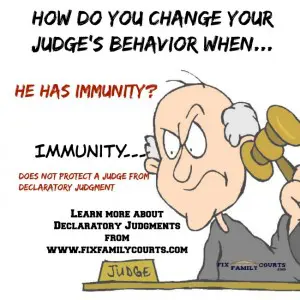
You can't sue judges, they have immunity, but you can…
Yes, judges have absolute immunity from facing consequences for their judicial actions. A completely unaccountable bureaucrat is taking control of your child and he/she can’t be punished in any way even if they violate your rights willfully and knowingly.
However, federal law states specifically that judges can be sued for injunctive relief if declaratory relief is unavailable against them. When the courts claim that declaratory relief is unavailable, and some do, that invokes the direct text of the statutes authorizing injunctive relief as jurisdictional authority that judges have a duty to exercise.
Why bother suing them then, if they can’t be held accountable?
While you can’t hold them accountable you can force them to change their behavior. You cannot sue judges for financial damages and if you try your suit will be kicked out. However, you can absolutely sue your judge for declaratory and injunctive relief. This means you have a higher court declare that what the judge is doing violates a statute or constitutional provision and tell the judge not to do it again.
You can’t punish a judge for violating your rights but other judges can punish your judge for violating their orders. If your judge violates an injunction their orders can be declared void and the judge can be sanctioned and even jailed for contempt.
This is why we like using the state and federal Declaratory Judgement Acts. They allow you to have the judge’s actions declared unconstitutional and block them from continuing those acts. It would be much more satisfying to sue a judge for ten million dollars but the system is rigged against us doing that. Nevertheless, we are not without power to force change.
We make it easy for you and your attorney to use this powerful but underused tool to change the system not only for yourself but for others as well.
Go to the Motions page if you want to learn more about how you can get started.
Have more questions, contact us!
Judicial Corruption
It is important to recognize that we are fighting pure judicial corruption at every level. Some federal appellate courts have clearly held that holding state family codes to constitutional limitation is entirely within their authority. If there are other state actors in your case such as a Guardians ad Litem they can be sued for civil rights violations and to challenge the family code as well
There is Another Path
There is another path we are developing under the Thirteenth Amendment and federal civil and criminal statutes enforcing its terms. The Thirteenth Amendment is a different animal entirely as it applies to limit private actors as well as state actors where Fourteenth Amendment claims apply only against state actors.
This means you can sue your ex or their attorney directly under a Thirteenth Amendment claim where the unconstitutionality of the family code becomes an element of the Thirteenth Amendment violation. This gives you a direct vector from which to challenge the constituionality of the family code. These federal statutes appear to be written specifically to defeat judicial claims of absoute immunity and we intend to use them that way.
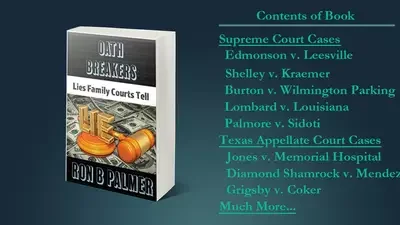
If you are interested in this state action issue, our book "Oath Breakers: Lies Family Courts Tell" explores these topics and introduces you to a Supreme Court case regarding the constitutionality of a child custody judge's best interests of the child determination and how that action is specifically limited by the Fourteenth Amendment. This case provides four core holdings that prove your state's family code to be unconstitutional where it applies best interest to limit fundamental rights. It holds that judges do NOT have free ranging authority to protect children from imagined harms. It holds that best interests of the Child is a state policy that is less than comepelling. It holds that the child custody judge and the child custody court are state actors limited by the Fourteenth Amendment. And it holds that the child custody judge's best interests of the child determination is subject to established standards of constitutional review.
Where parental rights are fundamental and where child custody orders limit speech and association through prior restraint, compelling justification is constitutionally mandated, but Best Interest can NOT provide compelling justification. Fundamental rights may NOT be infringed under broad authority but rather require narrow specificity before infringements may be considered constitutional. Broad best interest discretion is facially unconstitutional and your judge knows this.
We don't need to invent new law or get into novel arguments to prevail, the precedent is absolutely clear and controlling. What we have to do is find an honest court in which to raise these claims, or to make it so obvious in the state case that your judge gives you what you want out of fear that the entire unconstitutional scheme will come crashing down on them.
A time, in the near future, is coming when a child custody judge will feel the weight of this evil scheme crashing down upon them. If we make enough noise, new attorneys will refuse to make themselves liable for the damages awards that they will ultimately be held to pay. New judges are NOT going to go along with a scheme that is more and more likely to come crashing down on them with every new parent who fights back.
Copyright 2016 - 2025 Fix Family Courts. All Rights Reserved.
Fix Family Courts Social Media Links